About Diglossa gloriosissima Chapman, 1912
Chestnut-bellied flowerpiercer (Diglossa gloriosissima Chapman, 1912) is a small montane tanager belonging to the genus Diglossa. Like other members of this genus, it uses its slender upturned bill to pierce the base of flowers to get nectar.
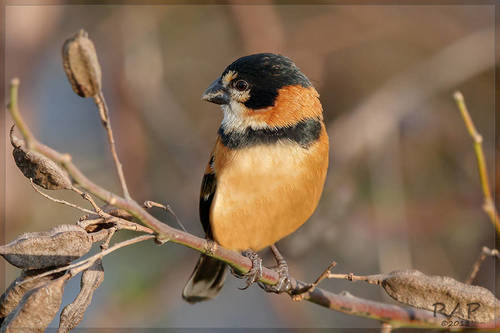
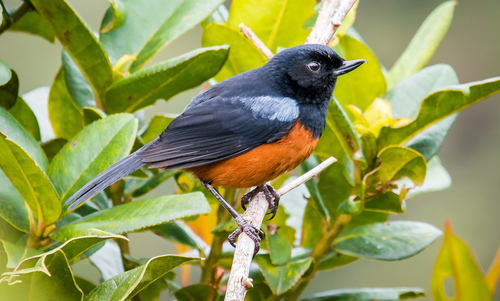
This species measures 14–15 cm in total length. Male wingspan is 75 mm, while female wingspan is 70 mm. Adult males have deep glossy black plumage on the head, upper breast, nape, back, wings and tail. The lesser wing-coverts are bluish-grey, and a bluish-grey wash also appears on the rump. The lower breast, belly and vent are deep rufous-chestnut, with black markings on the flanks. Undertail coverts are black. The bill is black, and the feet and tarsi are grey. Adult females are similar to males, but have more extensive bluish-grey colour on the rump. Juveniles are also similar to adults, but their black areas are duller; their lesser wing-coverts and rump are black, their chestnut areas are marked with black streaks, and their lower mandible is yellow with a dark tip. The subspecies D. g. boylei differs from the nominate subspecies by having uniformly chestnut flanks, sides, and undertail coverts.
This species is only recorded from a small number of discontiguous locations in the highlands of the Western Andes of Colombia. Recent populations have been observed in several Colombian departments: Antioquia (Paramillo Massif, Páramo de Frontino, Jardín area, Páramo del Sol, and Farallones del Citará); Cauca (Serranía del Pinche and southwest of Popayán); Chocó (Gorrión Andivia Bird Reserve); and Risaralda (Cerro Montezuma in Parque Nacional Natural Tatamá). Because much of its potential range lies in high, remote areas, additional unrecorded populations may still exist. It occurs at elevations between 3000 and 3800 m, except at Cerro Montezuma where it is regularly found as low as 2400 m. Its typical habitats are open páramo, shrubby sub-páramo, and elfin forest edges. It favours shrubby Polylepis forests, including Polylepis quadrijuga, as well as other small trees such as Escallonia and Baccharis.
Because the high-altitude regions of the northern Western Cordillera are remote and, until recently, had high levels of guerilla activity, birds of this area have not been well studied. The chestnut-bellied flowerpiercer is no exception; there were no confirmed records of the species between 1965 and 2003, so relatively little is known about its ecology. Evidence of reproduction, including females in breeding condition and nest construction, indicates that breeding occurs in February and August. At one páramo site, the species has been observed feeding on flowers of Melastomataceae and Ericaceae species, mainly from the genera Cavendishia, Psammisia and Thibaudia, as well as flowers from Loranthaceae and epiphytic bromeliads. Like other flowerpiercers, it likely also forages for small insects. At the Cerro Montezuma location, individuals have been observed visiting hummingbird feeders. This is a territorial species that only forms pairs during nesting. It has been seen moving in family groups of up to five individuals, and also associates with mixed-species foraging flocks. At Páramo Frontino, chestnut-bellied flowerpiercers and black-throated flowerpiercers (Diglossa brunneiventris) hold mutually exclusive territories.