About Diglossa cyanea (Lafresnaye, 1840)
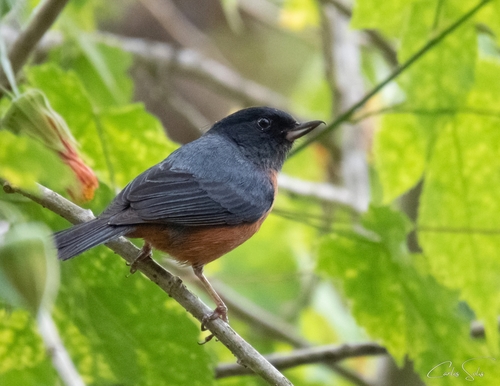
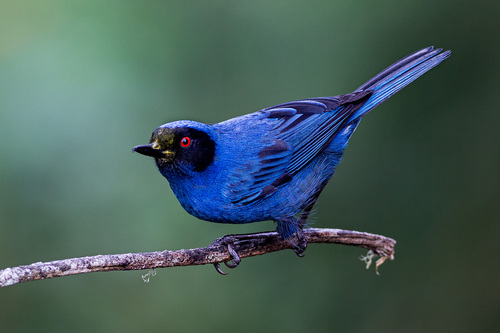
The masked flowerpiercer (Diglossa cyanea) grows to a length of about 15 cm (6 in). Adult males are deep ultramarine blue with a dark mask. They have a large, black, upturned beak with a characteristic hook on the tip of the upper mandible, and a bright red iris. Females have a similar overall appearance but are completely duller in coloration. Juveniles have a reddish-brown iris. Across the species' range, its song varies geographically: at the northern end of the range, the song is a series of reed-like notes that ends in a twitter, while at the southern end, it is a jangling series of high-pitched notes that ends with several lengthy "tseee" notes. These song differences suggest that northern and southern populations may be separate species. The masked flowerpiercer is endemic to the Andes mountain range in South America, with a range extending from Venezuela and Colombia, through Ecuador and Peru, to Bolivia. It inhabits montane forest, cloud forest, secondary forest, scrubby woodland, and forest edges, at altitudes between approximately 2,000 and 3,500 m (6,600 and 11,500 ft). This bird is most often seen in small groups or mixed-species flocks. It forages through foliage for insects and fruit, and probes into flowers with its beak. The flowers of the small tree Axinaea sclerophylla are pollinated by birds, with pollen released in a puff when the stamens are manipulated. During one research study, the only bird observed visiting these flowers was the masked flowerpiercer, which pulled off and consumed the stamens one at a time. Breeding occurs between June and September in Colombia, but across the rest of the species' range, juveniles have been observed at various times of year. The nest is cup-shaped, built in a bush, constructed from mosses and dry grasses, and lined with feathers. Eggs are pale bluish-green, with blotches and speckles of reddish-brown.