About Digitaria ischaemum (Schreb.) Muhl.
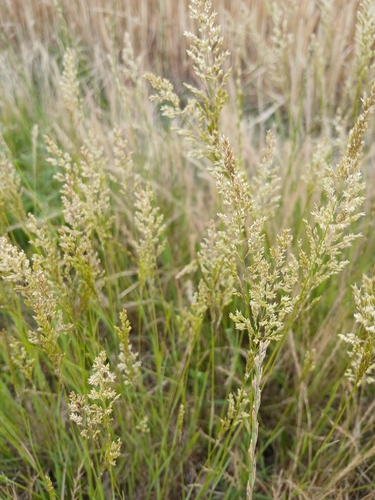
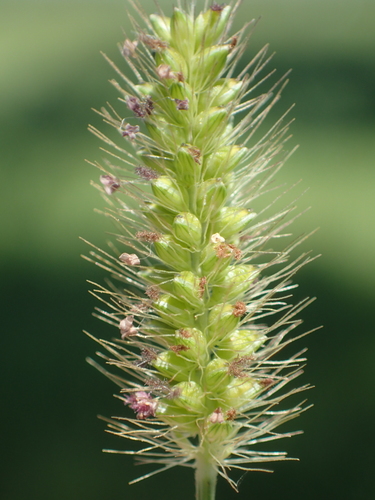
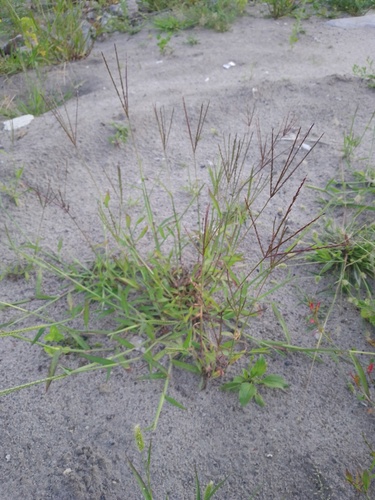
Smooth crabgrass, scientifically Digitaria ischaemum (Schreb.) Muhl., produces flowers that grow in clusters of 2 to 6. These clusters form spike-like structures 1½ to 4 inches long, arranged in a finger-like pattern at the tips of branching stems. Its small flower spikelets are egg-shaped, and grow in pairs along the stem: one spikelet grows on a short stalk, and the other grows on a longer stalk. Each spikelet contains one fertile flower. The small bracts at the base of each spikelet are uneven in size: one is almost invisible or entirely absent, while the other is covered in short hairs. The bracts surrounding the flowers are similarly sized, with one being hairy and the other marked with tiny pits. Flower styles and stamens extend out from the tip of the spikelet. The stem that holds the flower spikes is green or purple, winged, approximately 1 mm wide, and all spikelets are arranged on just one side of this stem. The leaves of smooth crabgrass are arranged alternately, growing up to 4 inches long and ¼ inch wide. They are mostly flat and hairless, except for hair growth at their base. Leaf sheaths are open at the front, sometimes bear a few long hairs near the top but are mostly hairless. They wrap loosely around the stem, and often have a ridge along their back. The ligule is white and very short, measuring less than 1 mm. The stems, called culms, are hairless, and branch out from the base. They are mostly light green, but may turn purple near the base. Stems often spread outward, and may root at their joints, called nodes. Nodes are hairless, and can be green or purplish. As smooth crabgrass matures, its spikelets turn dark purple. The absence of the first glume, and the hairs on the second glume and lemma, become more noticeable as the plant matures. Its seeds are oval-shaped, and range in color from dark brown to almost black. This species grows in terrestrial habitats. It has been recorded in central Europe, Japan, and the U.S. states of Connecticut, Maine, Massachusetts, New Hampshire, Rhode Island, and Vermont.