About Digitaria insularis (L.) Mez ex Ekman
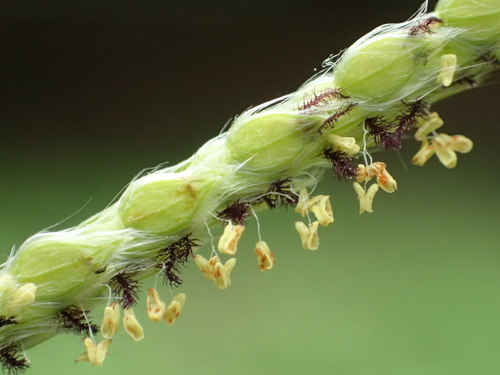
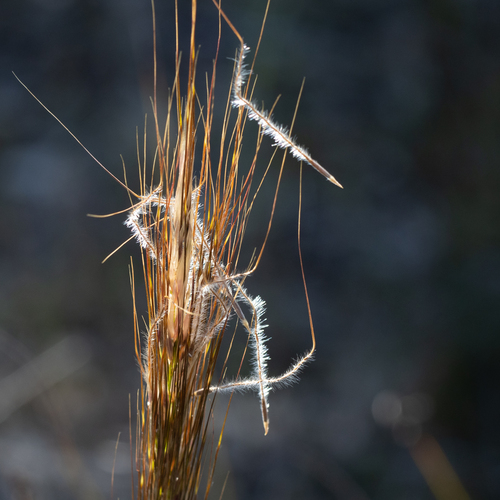
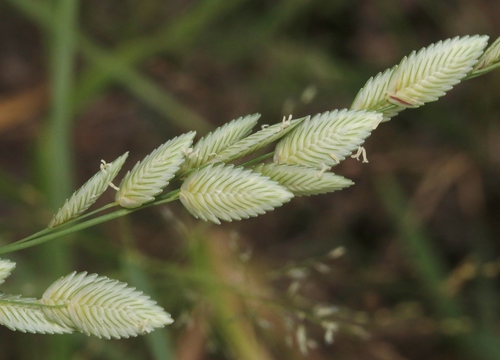
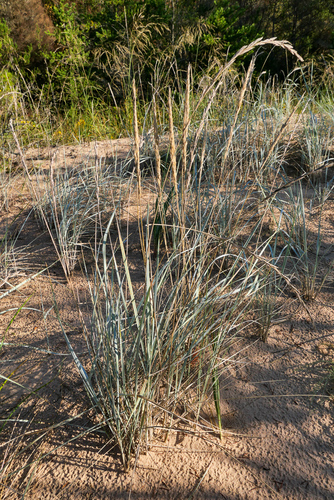
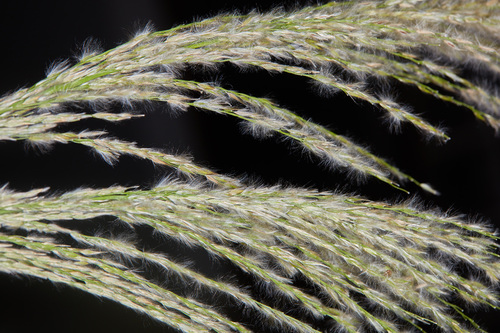
Digitaria insularis is a tufted perennial bunchgrass with very short, swollen rhizomes. Its erect stems grow 80 to 130 cm tall, branch from the lower and middle nodes, have swollen bases covered in woolly bracts, and have glabrous internodes and nodes. Most leaf sheaths are papillose-pilose. The ligule is 4–6 mm long. Linear leaf blades are 20–50 cm long and 10–20 mm wide. The inflorescence measures 20–35 cm long, and holds numerous clusters that are 10–15 cm long. Each cluster has a solitary triquetrous, scabrous rachis 0.4–0.7 mm wide. Spikelets are lanceolate, 4.2–4.6 mm long, grow in pairs, and are caudate. They are densely covered in brown or whitish trichomes up to 6 mm long, which extend up to 5 mm from the apex of the spikelet. The lower glume is triangular to ovate, up to 0.6 mm long, enervate, and membranous. The upper glume is 3.5–4.5 mm long, acute, 3–5 nerved, and ciliated. The inferior lemma is the same length as the spikelet, acuminate, 7-nerved, and covered with silky hairs. The upper lemma is 3.2–3.6 mm long, acuminate, and dark brown. Anthers are 1–1.2 mm long. Digitaria insularis is native to tropical and subtropical Americas. It is a common species that grows in disturbed areas and on beaches, at altitudes up to 1,400 m (4,593 ft) above sea level. Within its native range in Brazil, Paraguay, Bolivia and Venezuela, it is a pervasive weed that grows outside its natural habitats. It has been introduced to tropical Asia, some Pacific islands and other regions. In some introduced locations, such as Hawaii and Papua New Guinea, it is classified as an invasive species.