About Digitaria eriantha Steud.
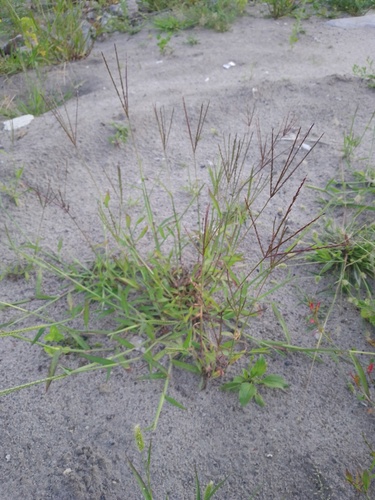
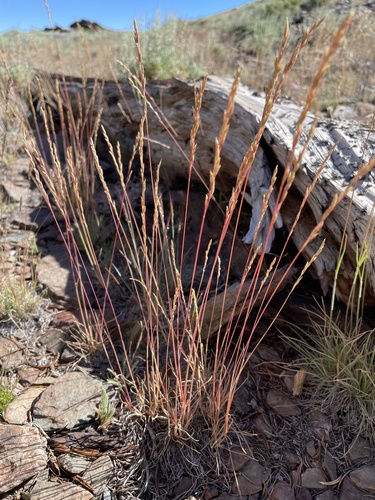
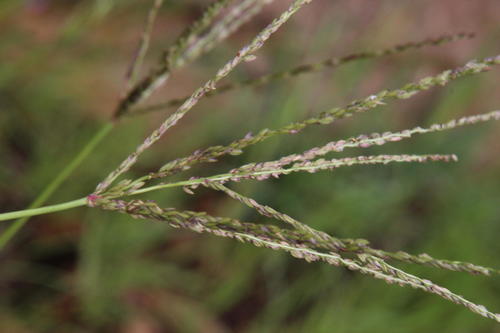
Digitaria eriantha Steud. is a monocot species belonging to the grass family Poaceae. It is a perennial grass, and may be stoloniferous or tufted. It forms a dense tussock with extended stolons, which can be either hairy or hairless. Individual culms grow erect or ascending, reaching heights between 35 and 180 cm. The lowest basal leaf sheaths are densely hairy, and very rarely smooth. Leaf blades typically measure 5–60 cm long and 2–14 mm wide, and can be either hairy or smooth. Each inflorescence usually has six or seven spicate branches, each of which holds numerous florets. The spikelets of this species are generally 2–4 mm long; the lower glume is the same length as the spikelet, and the upper glume holds the lemma, which is covered with 1 mm long hairs. Digitaria eriantha, commonly known as digit grass, is native to Africa, where it occurs in Angola, Botswana, Mozambique, South Africa, Zimbabwe, Namibia and Eswatini. It is cultivated in Australia and Argentina, and is currently distributed across many humid subtropical and tropical regions. It goes by a wide range of common names, including common finger grass, digit grass, pangola grass, and woolly finger grass in English; digitaria in French; pangolagras in German; and pangola and pasto pangola in Spanish. Digit grass is most commonly used for hay and pasture. It tolerates very heavy grazing and grows quite quickly.