About Dieteria bigelovii (A.Gray) D.R.Morgan & R.L.Hartm.
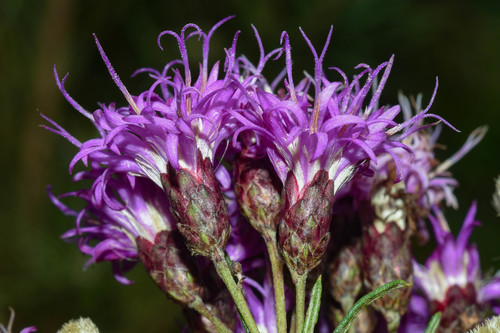
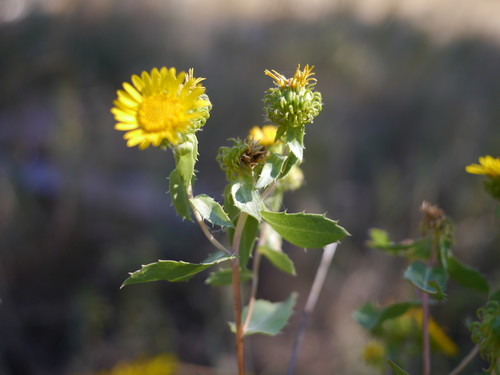
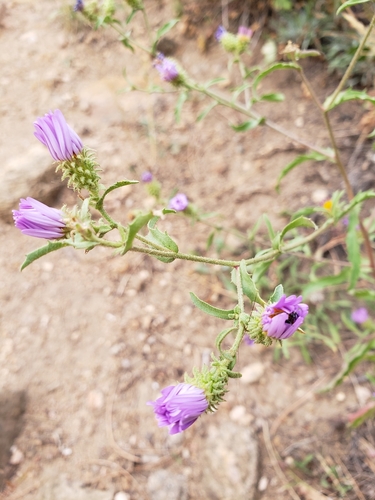
Dieteria bigelovii (A.Gray) D.R.Morgan & R.L.Hartm. is a biennial or perennial herb that reaches 30 to 90 centimeters (12 to 35 inches) in height. Its leaves are 5 to 10 centimeters (2 to 4 inches) long and edged with sharp teeth. From August to October, the plant produces several flower heads around 4 centimeters (1 1/2 inches) wide. The blue or purple ray florets are female, while the yellow disc florets are bisexual; ray florets close upwards when in shade. The fruit resembles a seed and has bristles at its tip. True asters are similar in appearance, but usually do not have spiny or divided leaves. This species is native to the southwestern United States, occurring naturally in Arizona, New Mexico, Utah, Colorado, and Albany County, Wyoming. It grows in open areas within coniferous forests. In 1993, NatureServe evaluated Dieteria bigelovii with a global rank of G4, meaning "apparently secure". This global rank indicates that Dieteria bigelovii has a fairly low risk of global extinction or collapse, thanks to an extensive range and/or many populations or occurrences, but that some concern is warranted due to possible local recent declines, threats, or other factors. At the state level, it is rated critically imperiled (S1) in Nevada, imperiled (S2) in Wyoming, and vulnerable (S3) in Arizona.