About Dienia ophrydis (J.Koenig) Seidenf.
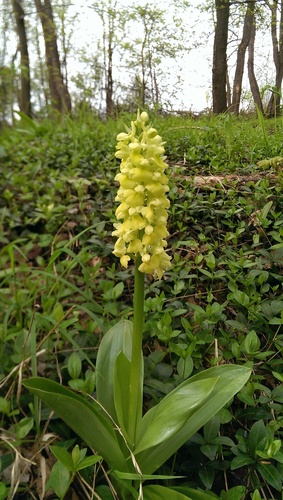
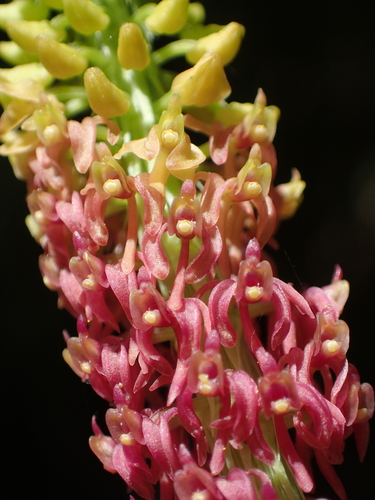
Dienia ophrydis is a terrestrial, deciduous herb that grows from fleshy, cone-shaped stems that measure 100–200 mm (4–8 in) long and 10–20 mm (0.4–0.8 in) wide. This species produces between three and six bright green leaves, with shapes ranging from broadly lance-shaped to egg-shaped. The leaves are 100–300 mm (4–10 in) long, 50–90 mm (2–4 in) wide, and have wavy edges. A large number of small non-resupinate flowers, colored greenish, brown, reddish, or purplish, grow crowded along a brittle, wiry flowering stem that is 150–300 mm (6–10 in) long. Each individual flower is 5–6 mm (0.20–0.24 in) long and wide. The dorsal sepal is narrow oblong, about 3 mm (0.1 in) long and 1.5 mm (0.06 in) wide, and curves downwards. The lateral sepals are egg-shaped, about 3 mm (0.1 in) long and 1 mm (0.04 in) wide, and curve around the labellum. The petals are linear in shape and similar in size to the sepals. The labellum is broadly egg-shaped, about 2.5 mm (0.1 in) long and 2 mm (0.08 in) wide. It has three blunt teeth at its tip, with the middle tooth being the longest, and has a deeply pouched base. Flowering occurs between December and April. Dienia ophrydis grows in wet forests, most often near streams and in swampy areas. It is the most widespread species in its genus Dienia, and can be found in China, Cambodia, Bhutan, India, Japan, Laos, Malaysia, Myanmar, Nepal, the Philippines, Sri Lanka, Singapore, Thailand, Vietnam, New Guinea, and northern Queensland.