About Dicladispa testacea (Linnaeus, 1767)
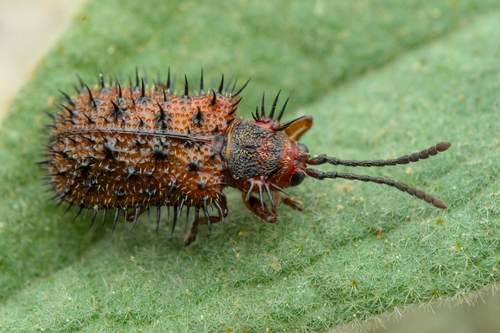
Dicladispa testacea is a brownish-orange beetle whose exoskeleton is covered in black spines. Mature individuals reach approximately 5 millimeters in length. This species lays yellowish-white, oval-shaped eggs. The female beetle bores a hole into the underside of a host plant leaf, and lays up to two eggs in this hole. The larvae of Dicladispa testacea are herbivorous; they feed on host plant leaves and create leaf mines.
Dicladispa testacea is distributed across most of Europe and the eastern Mediterranean. In Europe, it has been recorded in Albania, Bulgaria, Croatia, France, Greece, Italy, Portugal, Spain, Switzerland, Serbia and Montenegro, the United Kingdom, and Türkiye. In Asia, it has been recorded in Cyprus, Israel, Lebanon, Syria, and Türkiye. In North Africa, it has been recorded in Algeria, Morocco, and Tunisia.
Dicladispa testacea is monophagous, feeding exclusively on plants in the family Cistaceae, particularly species in the genera Cistus and Helianthemum. It can occasionally be found in gardens where its host plants are grown as ornamentals.