About Dichanthelium strigosum (Muhl. ex Elliott) Freckmann
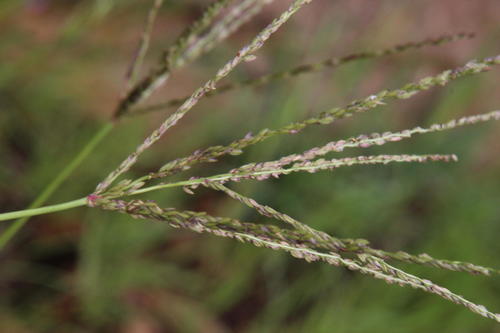
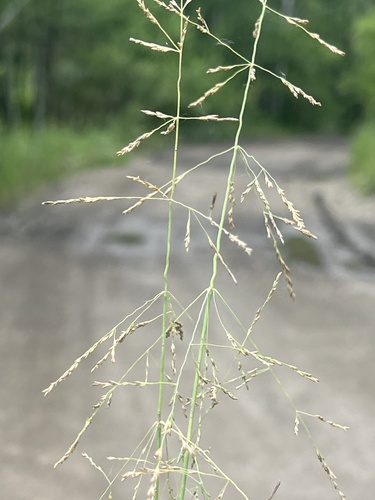
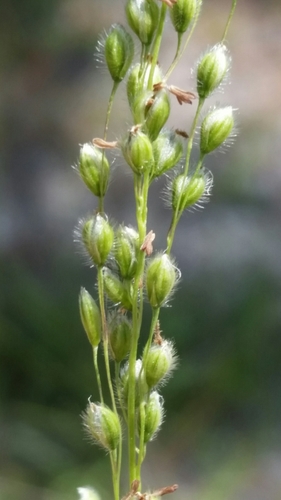
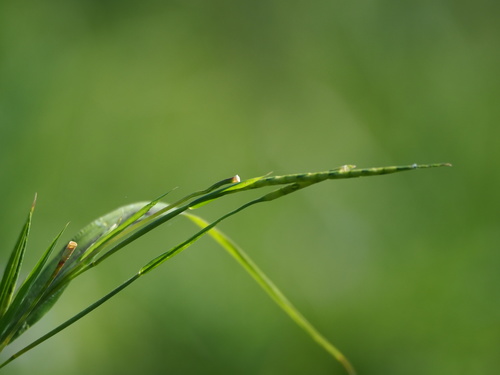
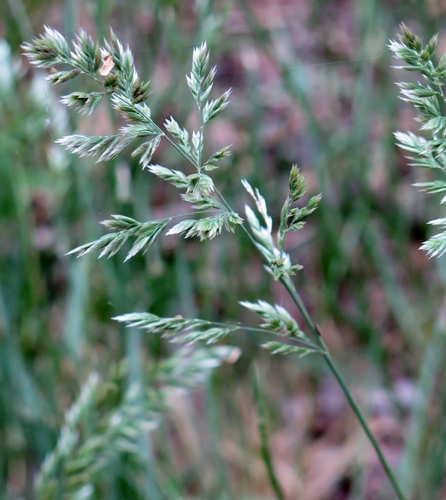
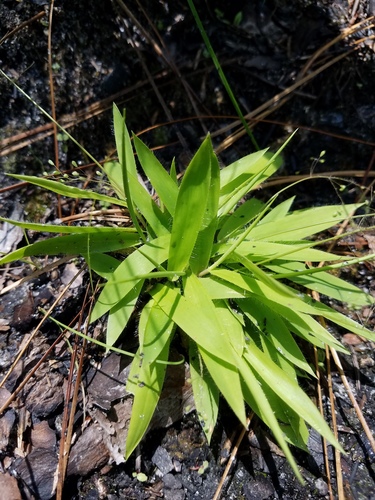
Dichanthelium strigosum can be distinguished by its basal leaf rosettes and occasional branching from nodes located above the rosette. This species produces both spring and fall leaves. Its stems grow 10–50 cm tall, bearing long, soft hairs on the internodes and have bearded nodes. Leaf blades are 2–6 mm wide and up to 6 cm long, with soft hairs on both surfaces and long ciliate margins. Leaf sheaths range from hairy to nearly smooth, and ligules are ciliate and measure 1–2.5 mm long. The panicle is 5–7 cm long and 3–5.5 cm wide, with softly hairy, spreading branches. Spikelets are obovoid to broadly ellipsoid, measuring 1.2–1.6 mm, are typically smooth, two-flowered, with a sterile lower floret and a fertile upper floret. The glumes and sterile lemma are glabrous and acute, while the hardened fertile lemma and palea do not have hyaline margins. Grains are 0.8–1 mm long, broadly ellipsoid to nearly round, and range in color from yellowish to purplish. Dichanthelium strigosum var. glabrescens occurs in the southeast United States, ranging from Georgia and Florida west to Louisiana, with disjunct populations in southeast North Carolina, and northeast and southeast South Carolina. This variety is also found in the West Indies and Belize, and grows in bogs, low open sandy pinelands, hammocks, wet pine savannas, and flatwoods. Dichanthelium strigosum var. leucoblepharis occurs from North Carolina south to northern Florida, west to Texas, and is also found in Mexico. It grows in sandy, acidic soils of pinelands. Dichanthelium strigosum var. strigosum occurs from southeast Virginia south to Florida, west to Texas. It is also found in eastern Mexico, Mesoamerica, northern South America, and the West Indies. It grows in moist soils of pine flatwoods, savannas, and pocosins.