About Dichanthelium dichotomum (L.) Gould
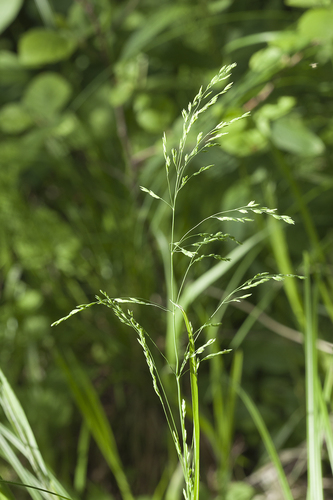
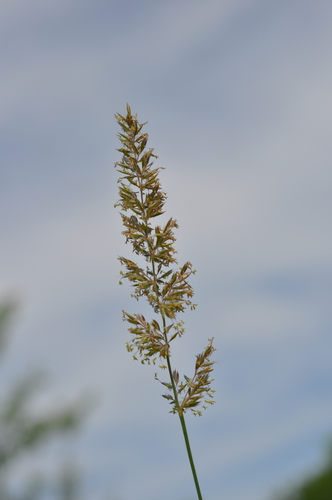
Dichanthelium dichotomum (L.) Gould produces distinct basal rosettes, and occasionally branches from nodes located above its base. Its culms grow between 20 and 110 cm tall, ranging from weak to stout in texture. Culm nodes are either densely covered in backward-facing hairs, or smooth, and the culm internodes are glabrous. Leaves grow both at the base of the plant and along the stem; leaf blades reach up to 12 cm long and 3–12 mm wide, and may be softly hairy, shaggy, or smooth on both surfaces. Leaf margins are typically rough, and sometimes fringed with hairs. Leaf sheaths range from glabrous to pilose or villous, and ligules are ciliate, sometimes reduced or absent. The inflorescence is a panicle 3–12 cm long and 2–8 cm wide, with spreading to ascending branches that are smooth or slightly roughened. Spikelets are 2-flowered and broadly ellipsoid. The first glume is glabrous and measures 0.5–0.8 mm long. The second glume and sterile lemma measure 1.4–2.4 mm long, are glabrous or softly hairy, and have an obtuse shape. Fertile lemmas and paleas are hardened, measure 1.4–2.4 mm long, and do not have hyaline margins. The grain is broadly ellipsoid to nearly round, yellowish to purplish, and 1–1.2 mm long. Two varieties of this species have documented distributions and habitats. Dichanthelium dichotomum var. dichotomum occurs from southern Canada and Michigan in the north, south to Florida and Texas. It grows in wet-mesic to dry woods, thickets, and woodland openings. Dichanthelium dichotomum var. nitidum (Lam.) occurs from Pennsylvania and New Jersey in the northeast, south to Florida, and west to Missouri and Texas. It is also found in The Bahamas, the West Indies, and from Mexico south to Venezuela. This variety grows in moist sandy or peaty soil in wet pine savannas, pocosin ecotones, marshes, swamps, and coastal wet meadows, and it is fire tolerant.