About Dichanthelium boscii (Poir.) Gould & C.A.Clark
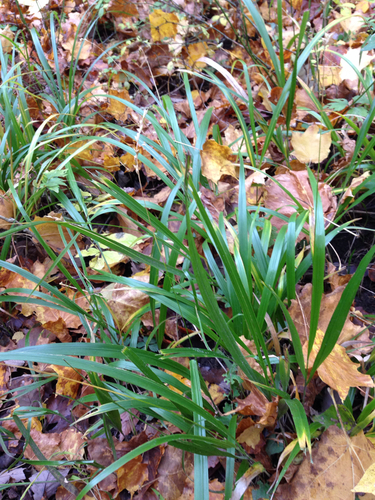
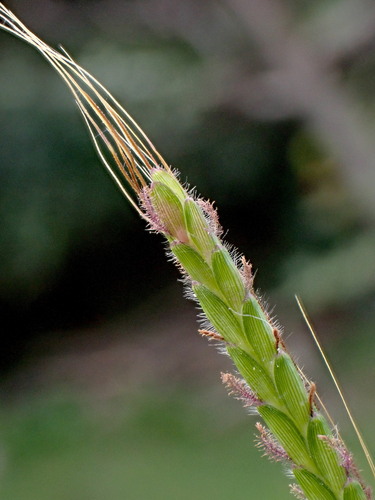
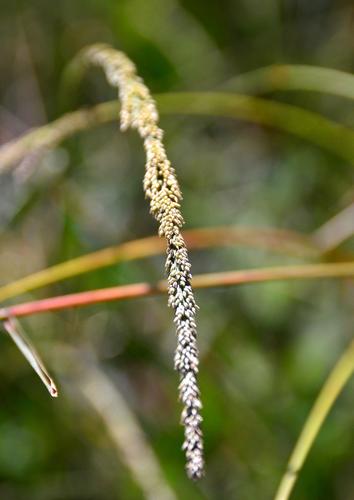
Dichanthelium boscii is a perennial grass species that forms distinct basal rosettes, and occasionally produces branches from nodes located above its base. It produces both basal leaves and leaves that grow along its stems (cauline leaves) in both spring and fall. Its culms (stems) reach 20–65 cm in height; nodes of the culms have retrorse (downward-pointing) beards of hair, while the internodes are glabrous (smooth, hairless), puberulent (covered in fine short hairs), or papillose-pilose (hairy with bumpy hair bases). Leaf blades are broad, growing up to 13 cm long and 12–35 mm wide, and may be glabrous, puberulent, or pilose (covered in longer distinct hairs) on both blade surfaces. Leaf blade margins are ciliate, fringed with fine hairs. Ligules are ciliate, and measure 1–1.3 mm in length. The flowering panicle measures 3–11 cm long and 1–8 cm wide, it has a villous (densely long-haired) rachis, with branches that range from spreading to ascending in orientation. Spikelets are ellipsoid in shape and 3.7–4.2 mm long, their pedicels range from villous to glabrous. The first glume is acute in shape, 1.5–2.2 mm long, and may be glabrous or pubescent. The second glume and the sterile lemma are puberulent to short-villous, acute, and match the full length of the spikelet (3.7–4.2 mm). The fertile lemma and palea also measure 3.7–4.2 mm long, are hardened, and lack hyaline (translucent) margins. When mature, the grain (seed) is broadly ellipsoid to sub-globose, around 2 mm long, and ranges in color from yellowish to purplish. Dichanthelium boscii occurs in a geographic range extending from Massachusetts and Illinois, south to northern Florida and eastern Texas. It grows in shaded to partially-open, mesic to dry woodlands.