About Dichanthelium aciculare (Desv.) Gould & C.A.Clark
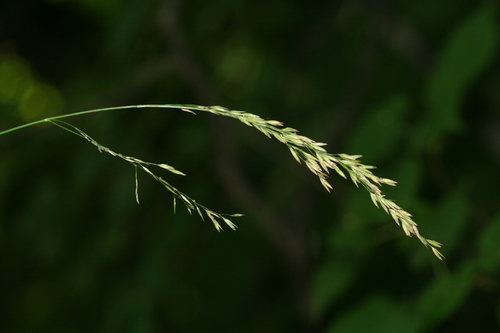
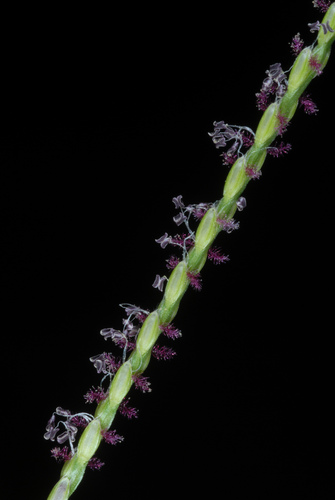
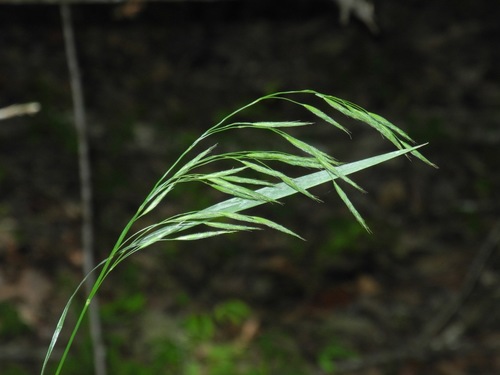
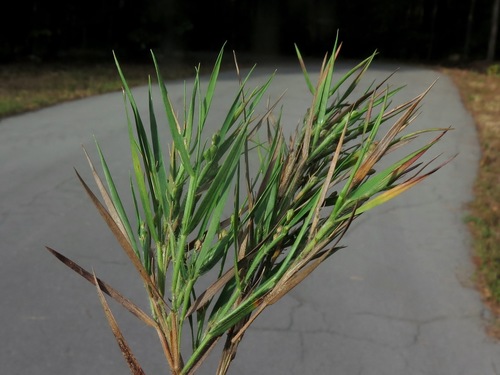
Dichanthelium aciculare is a perennial grass that forms distinct basal rosettes, and occasionally branches from nodes located above its base. It produces both basal and cauline (stem) leaves in spring and fall. Its culms grow 15–60 cm tall, with bearded nodes and long-pilose internodes. Leaf blades can reach up to 8 cm in length. Lower blades are 1–6 mm wide, while the uppermost blades are less than 2 mm wide. Blades may be either glabrous or pilose on both surfaces, have glabrous margins, and often bear long cilia at the base. Leaf sheaths are pilose or puberulent, and ciliate ligules measure 1–3 mm long. In fall, the blades become narrow and involute, measuring 0.5–2 mm wide, and range from glabrous to sparsely pilose. The exserted panicles are 2–7 cm long and 1–5 cm wide, with a glabrous or puberulent rachis and spreading-ascending branches that are scaberulous, and occasionally pilose at the base. Spikelets are obovoid, 1.5–2 mm long, and grow on scaberulous pedicels. The first glume is glabrous, scarious, acute, and 0.6–0.8 mm long. The second glume and sterile lemma are pubescent or puberulent, obtuse, and 1.6–2 mm long. The fertile lemma and palea are 1.5–1.8 mm long, nerveless or faintly nerved, yellowish to brownish at maturity, lustrous, and either acute or obtuse. Grains are broadly ellipsoid to subglobose, yellowish or purplish, and approximately 1 mm long. In terms of distribution and habitat, D. aciculare occurs in the United States from New Jersey south to northern Florida, and west to Texas, Oklahoma, and Mexico. It is also found in the West Indies and northern South America, and grows in sandy woods and fields.