About Dicerandra frutescens var. cornutissima (Huck) D.B.Ward
Dicerandra frutescens is a rare flowering plant in the mint family, commonly called scrub mint or scrub balm. It is endemic to the Lake Wales Ridge in Highlands County, Florida, where its native habitat is rapidly lost to conversion for residential and agricultural use. It was federally listed as an endangered species in the United States in 1985.
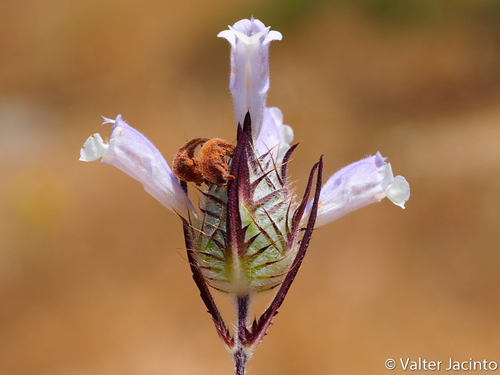
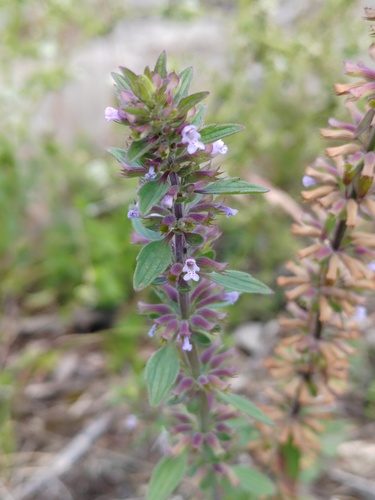
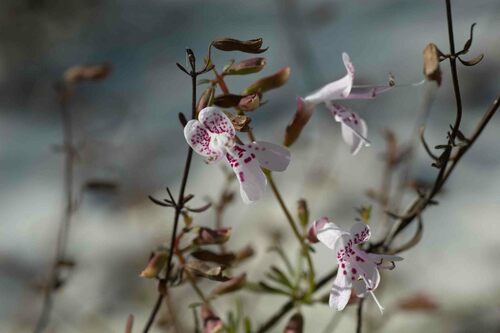
This shrub grows to approximately half a meter tall from a deep taproot. It is glandular, strongly aromatic with a characteristic mint scent. Its oblong leaves are roughly 2 centimeters long, with smooth edges, arranged oppositely on the stem, and dotted with visible oil glands. The inflorescence is a pair of flowers, each roughly 1.5 centimeters long. Each flower has a tubular throat and a lobed, lipped mouth. The corolla ranges from white to light pink, and the lips are dotted with darker pink markings. The protruding stamens are tipped with tiny horned anthers. This species blooms from August through October, and its flowers are pollinated by the bee-fly Exprosopa fasciata.
Several other taxa previously classified within D. frutescens have been separated and elevated to full species status: Dicerandra cornutissima in 1981, Dicerandra christmanii in 1989, and Dicerandra modesta in 2008. The variety described here grows in the endangered Florida scrub habitat of the botanically unique Lake Wales Ridge. By 1981, an estimated 74.4% of the native habitat in this area had already been destroyed or altered, and habitat loss continues today. There are fourteen known occurrences of this plant; nine are located on private property that may be slated for development, so their current status is uncertain, and some populations may already have been destroyed.
This plant grows in yellow sand scrub, which may be dominated by sand pine, by a mix of oaks (Quercus spp.) and scrub hickory (Carya floridana), or a combination of both vegetation types. This type of habitat is maintained by periodic wildfire, which clears large woody vegetation and creates open gaps that smaller plants like this species require to grow. Fire suppression is a major threat to this species. There is very little damage to these plants from disease or predation overall, but one moth species uses this plant as a larval host: the larva of Pyrausta panopealis. Unlike most other insects, this larva is unaffected by the plant's aromatic oils that deter other insect consumers. Additionally, the moth larva may protect itself from other insects by vomiting the plant's irritating oil all over its body.