About Dicentra formosa (Andrews) Walp.
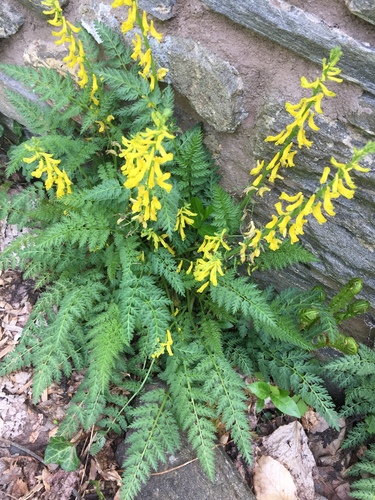
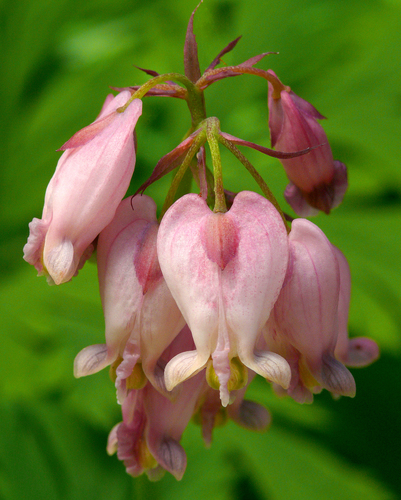
Pacific bleeding-heart, the common name for Dicentra formosa (Andrews) Walp., is a perennial herbaceous plant. It grows from a brittle rhizome at its base, and produces fern-like leaves that are divided three to four times. Mature plants reach 18 inches (45 cm) in height and spread to 24 inches (60 cm) across. Its flowers are pink, red, or white, shaped like hearts, and arranged in clusters of 5 to 15 at the top of leafless, fleshy stems that sit above the foliage. Flowering occurs from mid-spring to autumn, with peak bloom in spring. Each flower has four petals attached at the base: the two outer petals form a pouch at the base and curve outwards at their tips, while the two inner petals sit perpendicular to the outer petals and are connected at the tip. Two tiny, pointed sepals are located behind the petals. Seeds develop inside plump, pointed pods, and the plant readily self-seeds. After flowering, it often goes dormant for the summer, then re-emerges and flowers again in autumn. This species contains isoquinoline, a toxic alkaloid that is known to be fatal to cattle. Pacific bleeding-heart is frequently confused with fringed bleeding-heart (Dicentra eximia), and is often sold under that name. Fringed bleeding-heart is native to the Appalachian region, and can be distinguished by its narrower flowers and longer, more curved outer petal tips. The well-known related plant commonly called bleeding heart, Lamprocapnos spectabilis which is native to Asia, was previously classified in the same genus as Dicentra formosa. Pacific bleeding-heart is native to moist woodlands, forests, and streambanks, ranging from California north to British Columbia, and growing from sea level up to the subalpine zone. There are two recognized subspecies: Dicentra formosa subsp. formosa and Dicentra formosa subsp. oregona. Subsp. formosa occupies most of the species' full range: it grows from Vancouver Island and southern British Columbia south through Washington and Oregon to central California, found in the Coast Ranges, the Cascades, and the western slope of the Sierra Nevada. Subsp. oregona grows in a small area of southern Oregon and northern California, restricted to serpentine soils in the Siskiyou Mountains. The two subspecies can also be told apart by their appearance: Dicentra formosa subsp. formosa has leaves that are glaucous on the underside and never glaucous on the upper surface, and flowers that range from purple-pink to pink or white; Dicentra formosa subsp. oregona (often spelled oregana) has leaves that are glaucous on both the upper and lower surfaces, and flowers that are cream or pale yellow.