About Dicentra cucullaria (L.) Bernh.
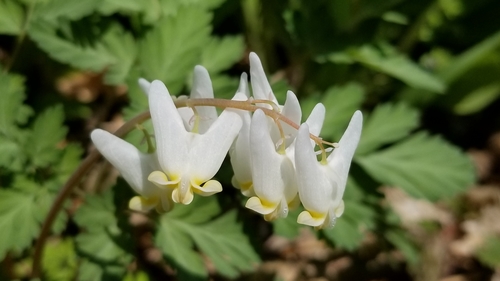
Dicentra cucullaria (L.) Bernh., commonly called Dutchman's breeches, has a rootstock made up of a cluster of small, teardrop-shaped pink to white bulblets, which are more accurately classified as miniature tubers. Its leaves are 10–36 cm (4–14+1⁄4 inches) long and 4–18 cm (1+1⁄2–7 inches) broad, with a 5–24 cm (2–9+1⁄2 inch) long leaf stalk (petiole). The leaves are trifoliate, with finely divided leaflets. Flowers are usually white, rarely lightly tinted pink, and measure 1–2 cm (1⁄2–3⁄4 inches) long. They grow in early spring in racemes holding 3 to 14 flowers, borne on 12–25 cm (4+3⁄4–9+3⁄4 inch) long flower stalks (peduncles). Unlike the closely related species Dicentra canadensis (squirrel corn), the flowers of Dicentra cucullaria have no fragrance. After pollination, the pistil develops into a slender seed pod that is 7–16 mm (1⁄4–5⁄8 inches) long and 3–5 mm (1⁄8–3⁄16 inches) wide, narrowed to a point at both ends. The capsule splits in half when its seeds are fully ripe. The seeds are kidney-shaped, with a faint net-like pattern, and each seed has a fleshy organ called an elaiosome that attracts ants. Dutchman's breeches is one of many plant species whose seeds are dispersed by ants, a process known as myrmecochory. Ants carry the seeds back to their nests, eat the elaiosomes, and deposit the seeds in the nest's debris, where the seeds are protected until they germinate. The seeds also benefit from growing in the nutrient-enriched medium of ant nest debris. After seeds ripen in late spring, the leaves and flower stems die back, and the bulblets remain dormant through the summer. In fall, the starch stored in the bulblets is converted to sugar, and the early development of the next spring's leaves and flowers takes place underground. Western populations of this species have sometimes been classified as the separate species Dicentra occidentalis, based on their often somewhat coarser growth habit, but these populations do not differ from many eastern plants found in Virginia's Blue Ridge Mountains. In terms of ecology, Dicentra cucullaria relies on bumblebees, especially Bombus bimaculatus, a common eastern North American bumblebee species, for cross-pollination. Its flower structure and pollination mechanism are adapted specifically for bumblebees, which are able to separate the flower's outer and inner petals. Bumblebees use their front legs to expose the stigma, stamen, and anthers, then sweep pollen forward with their middle legs before leaving the flower to return to their colony with the collected pollen. Pollination of Dicentra cucullaria occurs as bumblebees move between individual plants, while the bumblebees gain the pollen as a food source. All parts of the plant contain psychoactive compounds apomorphine, protoberberine, and protopine. When livestock consume the plant, these compounds cause intoxication, leading ranchers to call Dicentra cucullaria 'Staggerweed'. In cultivation, Dutchman's breeches was probably introduced to cultivation in England when Philip Miller brought it to the Chelsea Physic Garden; Miller likely received the plant from John Bartram. However, the species was not mentioned in American horticultural literature until the early 19th century. Two cultivated clones with pink flowers have been given cultivar names: 'Pittsburg', which turns pink only under certain growing conditions, and 'Pink Punk', which was collected by Henrik Zetterlund on Saddle Mountain in Oregon and produces more consistently pink flowers. Dicentra cucullaria grows best in rich, woodland soil with high organic matter content. It prefers moist to average moisture levels in soil, and grows best in full shade, partial shade, or filtered sunlight. For medicinal uses, Native Americans and early European American practitioners considered this plant useful for treating syphilis, skin conditions, and as a blood purifier. Dutchman's breeches contains several isoquinoline-type alkaloids that may affect the brain and heart. However, Dicentra cucullaria may be toxic, and it causes contact dermatitis in some people.