About Diaphania indica (Saunders, 1851)
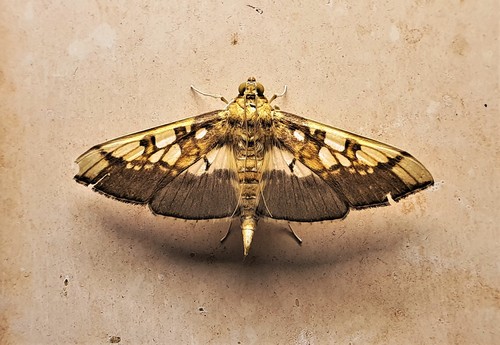
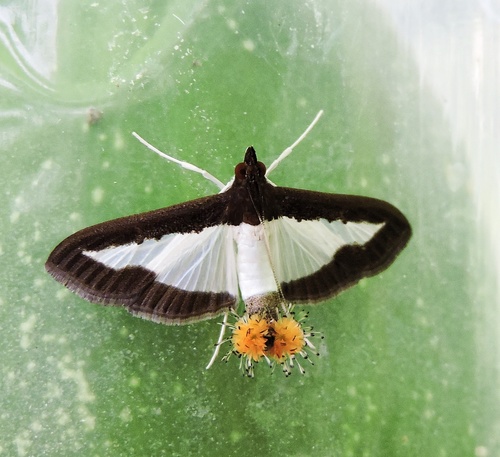
Diaphania indica (Saunders, 1851), commonly called the cucumber moth, has an adult wingspan of approximately 30 millimeters. Adult individuals have translucent whitish wings with broad dark brown borders. The lower body surface is whitish, while the top of the head, thorax, and the tip of the abdomen are brown. There is a tuft of light brown hair-like structures at the abdomen tip: this tuft is vestigial in males and well developed in females. The tuft is formed from long scales held in a pocket on each side of the 7th abdominal segment, and can be everted from these pockets to form the tuft. Unfertilized females are often observed resting with the tuft fully spread, forming two flower-like clumps of scales that move slowly to release their pheromones. The pheromones of this species have been identified and consist mainly of (E,E)-10,12-hexadecadienal and (E)-11-hexadecenal. To reliably distinguish Diaphania indica from its closest relatives, researchers must perform microscopic examination of its genitalia. In males, the clasper's harpe is twice as long as it is wide; the costa and sacculus run almost parallel, are strongly sclerotized, and end in a rounded cucullus. A thin spine extends from the center of the harpe, which is only weakly sclerotized elsewhere. The uncus is covered in bristles, ends in a small tube, and is slightly longer than the tegumen, which is about as wide as it is long. The vinculum is almost quadratic, and the anellus forms a small triangular plate that is more strongly sclerotized. The aedeagus is almost straight, strongly sclerotized on its lower side, and has a flattened curved process at its end. In female genitalia, the ostium is transverse and oval, and the antrum is broadly sclerotized. The ductus seminalis inserts from above, slightly before the forward edge of the antrum. The bursa copulatrix is long and slender, with the forward third being particularly narrow; its wall is covered in many short spines, and the hind end merges almost seamlessly into a short, barely distinguishable ductus bursae. The natural range of this moth extends from South Asia to southern China and Taiwan, and continues south through Southeast Asia to the Maluku Islands of Indonesia. It is also found in the Philippines, is widespread across Australia, and is a pest of cucurbits in the northern part of the Australian continent. It was likely introduced to oceanic islands via trade and transport of its host plants; these introduced locations include Fiji, Ponape in the Caroline Islands, the Marquesas Islands across different regions of the Pacific, and Mauritius in the western Indian Ocean. It has been reported from several localities in Africa, including occasional sightings in Narok, Kenya, where it is also thought to be an introduced species. One individual was also sighted 20 kilometers outside of Swakopmund in the Namib Desert on April 5, 25. As suggested by its common name, the caterpillar larvae of this moth are common agricultural pests. While the species is most well known as a pest of cucumbers, this is likely because cucumbers are widely cultivated rather than because the moth prefers cucumbers. D. indica is quite polyphagous, and actually prefers other members of the subfamily Cucurbitoideae (which are not as widely cultivated as cucumbers) over cucumbers. Typically, caterpillars feed on the leaves of their host plants, which are usually eurosids. Known host plants include members of the Cucurbitaceae family: calabash (Lagenaria siceraria), angled luffa (Luffa acutangula), Egyptian luffa (Luffa aegyptiaca), pumpkins (Cucurbita), cucumber (Cucumis sativus), snake gourd (Trichosanthes cucumerina var. anguina), and Trichosanthes tricuspidata. Known non-cucurbit host plants are Erythrina corallodendron (Fabaceae) and Levant cotton (Gossypium herbaceum, Malvaceae).