About Dianthus armeria L.
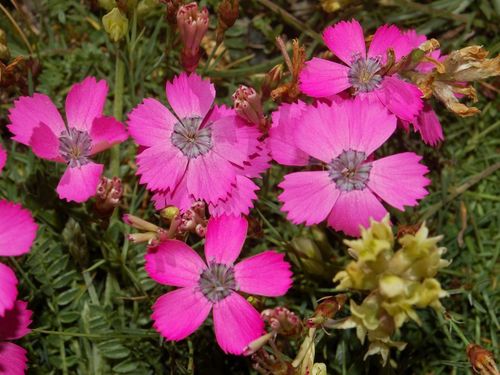
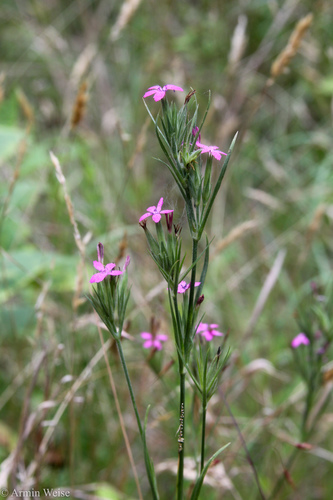
Dianthus armeria L. is an annual, biennial, or occasionally short-lived perennial herb that grows to roughly 60 centimetres (2.0 feet) tall and has a very slender appearance. It produces widely spaced, paired leaves; above these leaves, it branches rather sparingly. Its leaves are hairy, dark green, and narrow in shape. Short-stalked or stalkless clusters of deep-pink flowers grow at stem ends, surrounded by erect, hairy, leaf-like bracts; these clusters may also occur along the sides of stems. Each flower measures 8 to 13 millimetres (0.31 to 0.51 inches) across, with 5 lanceolate petals that have irregular serrated edges and small white spots on their upper surface. This species is native to Europe, where it is widespread as far north as 60°N in Scandinavia, extends east to Armenia and the Caucasus, and reaches as far south as Spain and Sicily. It has been introduced to North America, where it is now naturalized and widespread as an invasive species. In Britain, it is extirpated as a native species from Scotland; native populations are known from a few dozen sites in England and 4 to 5 sites in Wales, including a Flintshire nature reserve, a quarry near Pontypridd in Rhondda Cynon Taf, a site near a reservoir in the Port Talbot area, and a site along a farm track near Llanelli. It occupies open, periodically disturbed sites. While it is most commonly annual, it can also be biennial or short-lived perennial, with a maximum lifespan of less than two and a half years; new leaf rosettes form at the base of old plants from buds on their roots, confirming its short-lived perennial growth form. It flowers from July to September. Its flowers are scentless, are rarely pollinated by insects, and typically self-pollinate. Blooms close in the late afternoon. Each plant gradually releases around 400 seeds from its seed pods, though a small fraction of the seeds a plant produces may remain held on the plant over winter. It is widely grown as an ornamental garden plant. Beyond North America, populations have been introduced and naturalized in New Zealand.