About Dianella tasmanica Hook.f.
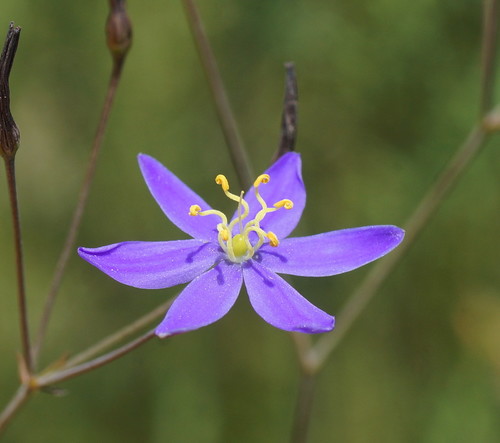
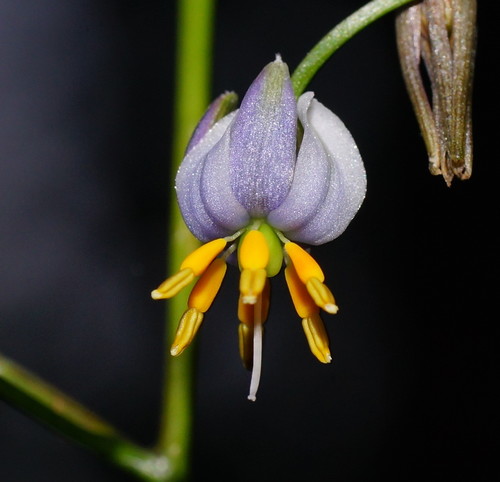
Dianella tasmanica Hook.f. is a strappy herbaceous plant that reaches 0.5 to 2 metres in both height and width, growing from a thick, spreading underground rhizome. Its green, linear, keeled leaves have finely toothed margins, and can grow up to 1 metre long and 1.5 to 4 centimetres wide. Small blue flowers, 1.5 centimetres in diameter, bloom from spring through summer, between August and February. These flowers are followed by small, roughly oval or globular violet berries, which are around 1.2 centimetres in diameter. This species is distributed from Dorrigo in New South Wales southwards into Victoria and Tasmania, where it grows either singly or in clumps in shaded locations within wet forests. Dianella tasmanica is a hardy plant that has been grown in Australian gardens and as a pot plant for many years. It prefers shaded conditions and regular moisture, and can also be grown as an indoor plant in a brightly lit space. Several cultivated forms are available: the variegated-leaved "Rainbow", the compact "Little Devil", and a salt-tolerant form with red-tinged leaves. The fruits of Dianella tasmanica are toxic to an unknown degree and are not suitable for eating. They are noticeably larger than the fruits of other Dianella species, and cause an irritating tingling sensation in the mouth when eaten. Aboriginal peoples have reportedly used the fruits to dye baskets, and the leaves may be used for weaving.