About Dianella nigra Colenso
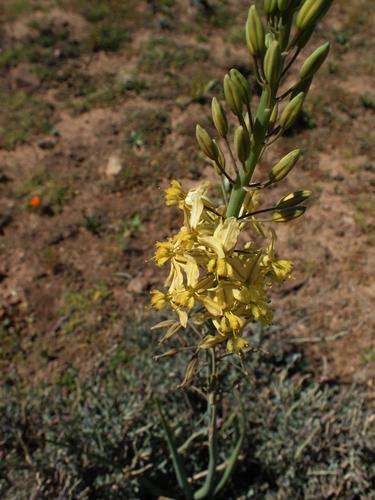
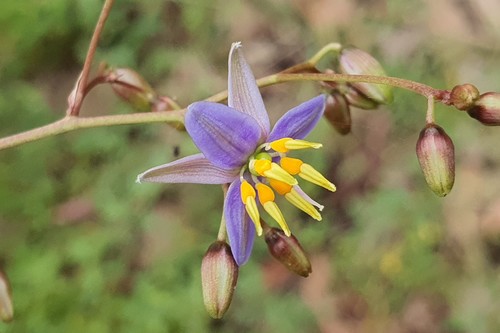
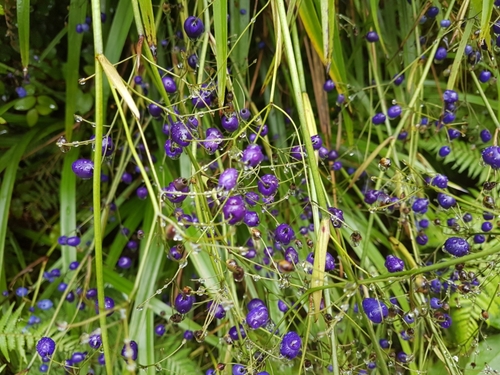
Dianella nigra Colenso is a species of perennial herb belonging to the family Asphodelaceae and subfamily Hemerocallidoideae. It is an evergreen, dense, tussock-like plant with horizontal rhizomes that can reach 150 mm long or more. Its leaves measure 250 mm–800 mm × 12 mm–18 mm (9.84 in–31.50 in × 0.47 in–0.71 in), are green to dark green, curved and hanging, with smooth leaf blades. Leaf bases range from light green to dark green, and the leaf sheaths have narrow red margins. Inflorescences can grow up to 1 m (3 ft 3 in) above the foliage, and panicles are 300–500 mm (12–20 in) long. Flowers are 9–11 mm in diameter, and flowering typically occurs in November and December. Sepals measure 4.4–4.5 × 1.6–1.7 mm, while petals measure 3.5–4.0 × 2.3–3.4 mm and are white to olive-green in colour. Glossy berries are 8–20 × 7–10 mm, and range from grey-white to violet-blue in colour. The black seeds of D. nigra are 1.8–2.1 × 2.3–3.0 mm long. This species is endemic to New Zealand. It is mainly found across the North and South Islands, and also occurs on the Three Kings Islands. It is generally distributed throughout the North Island. On the South Island, it is present in the Canterbury, Nelson, Marlborough, West Coast, and Otago regions, with a recorded population near Lake Wānaka. No herbarium records of the species have been collected from the Southland Region, but botanist Thomas Cheeseman noted that it occurs as far south as Foveaux Strait. In the 2023 New Zealand Threat Classification System, its conservation status is "Not Threatened". Dianella nigra typically inhabits coastal to montane environments, with a maximum recorded altitude of 1,100 m (3,600 ft) above sea level. It prefers to grow in partial shade on well-drained soils, most often beneath trees. It is able to colonise a wide variety of habitats, including coastal headlands, gumland scrub, clay banks, occasionally peat boglands, dense forest, and rarely subalpine scrub. It is also found in geothermal fields in the Taupō Volcanic Zone. Berries of the related Dianella haematica are dispersed by fruit-eating animals called frugivores, and silvereyes (Zosterops lateralis) eat these berries. The pollination strategy of D. nigra is not well-studied. D. nigra hosts leafminer weevils from the genus Microcryptorhynchus, which chew its leaves. Dianella nigra has several recorded Māori names: piopio, pēpepe, rēua, and tūrutu. According to ethnographer Elsdon Best, the only recorded use of this plant is using its leaves to call birds. There is a historical late 1800s record of an infant death linked to ingestion of its berries, which suggests the berries may be poisonous. Dianella species from other regions have historically been used as rat poison.