About Diadophis punctatus (Linnaeus, 1766)
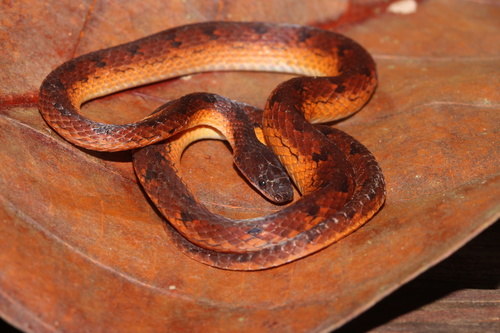
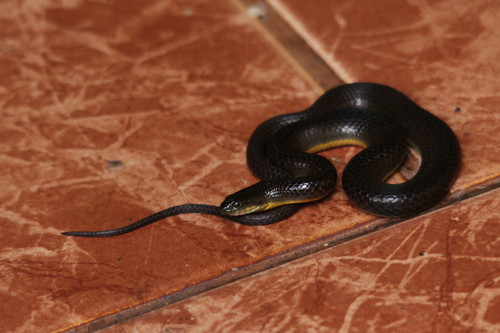
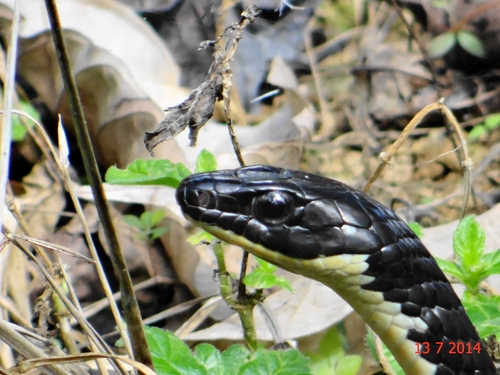
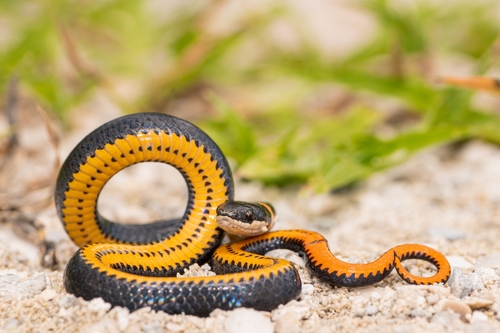
Diadophis punctatus, commonly called ring-necked snakes, have fairly consistent morphology across most of their range. Their dorsal color is solid, ranging from olive, brown, and bluish-gray to smoky black, interrupted only by a distinct yellow, red, or yellow-orange neck band. A small number of populations in New Mexico, Utah, and other isolated locations lack this distinctive neck band. In populations found across the U.S. Coastal Plains, the neck ring is often incomplete. Individual snakes may also have reduced or partially colored neck bands that are hard to distinguish; the band color may also be cream rather than bright orange or red. Head color is typically slightly darker than the rest of the body, and tends to be more black than grey or olive. On their ventral side, ring-necked snakes have yellow-orange to red coloration broken up by crescent-shaped black spots along the margins. Some individuals do not have the distinct ventral coloration, but almost always keep the black spotting. It is very rare for an individual to lack both ventral patterning and the neck band, so using these two traits is the simplest way to identify this species. Body size varies across the species' distribution. Most adults measure 25–38 cm (10–15 in) in length; the subspecies D. p. regalis is larger, reaching 38–46 cm (15–18 in). The maximum recorded size for the nominate subspecies D. p. punctatus is 52 cm (20.5 in). First-year juvenile ring-necked snakes are typically around 20 cm (8 in) long, and grow 2–5 cm (1–2 in) per year, with growth rate depending on developmental stage and resource availability. This species has smooth scales, with 15–17 scale rows at midbody. Males usually have small tubercles on their scales just forward of the vent, a trait that is usually absent in females. Ring-necked snakes are fairly common across most of the United States, with their range extending into southeastern Canada and central Mexico. In the phylogenetic lineage of ring-necked snake subspecies, Mexican populations diverged first. Eastern populations span the entire Eastern Seaboard, running continuously from the Gulf of Saint Lawrence through the Gulf Coast of Texas. Their range extends inland to northern Minnesota, and continues diagonally across the U.S. to include all of Iowa, eastern Nebraska, and most of Kansas. In the western United States, the distribution is much less continuous, with isolated, scattered population segments across most of the Pacific Northwest. Populations stretch from south-central Washington along the far West Coast into Mexico, with additional inland segments running through western Idaho, southern Nevada, and central Utah, continuing south through Arizona into central Mexico. Ring-necked snakes live in a wide diversity of habitats, and prefer areas that provide abundant cover and suitable denning sites. Northern and western subspecies occur in open woodlands near rocky hillsides, wetter environments with abundant cover or woody debris, ponderosa pine-Oregon white oak stands, mixed forests, and shrub steppe. Southern subspecies live primarily in riparian and wet environments, especially within more arid broader landscapes. Stebbins (2003) recorded this species as favoring moist habitats, with moist soil as the preferred substrate. Ring-necked snakes are not found at elevations above 2,200 m (7,200 ft). In northern regions, suitable dens are a key requirement for habitat. Dens are typically shared communally, and form in existing subsurface crevices or holes deep enough to avoid freezing temperatures. There is intraspecific variation in den site selection: aggregated groups of ring-necked snakes choose dens that average 3 degrees Celsius above their ideal body temperature, while solitary snakes select dens that maintain their ideal body temperature. As a woodland reptile, it is also commonly found under wood or discarded debris. This cover is used as a heat source instead of direct basking. To escape hot weather, the snakes either dig their own holes and burrows, or hide under rocks or other suitable cover. They are most often found in flatland forests. While they prefer to avoid human-made structures, ring-necked snakes will readily use urbanized areas as refuge from predators. Ring-necked snakes are generally active from March through October each year. Ring-necked snakes usually mate in the spring. For some subspecies, however, mating takes place in the fall, followed by delayed implantation of fertilized eggs. Females attract males by secreting pheromones from their skin. Once a male locates a female, he drags his closed mouth along the female's body. He then bites the female around her neck ring, and maneuvers to align their bodies to allow sperm to be inserted into the female's vent. Females lay their eggs in loose, well-aerated soil under a rock or inside a rotted log. Clutches contain three to ten eggs, which are deposited in June or July and hatch in August or September. The eggs are elongated, with a white body and yellow ends. Hatchlings are precocial, and can fend for themselves with no parental care.