About Diacrisia sannio (Linnaeus, 1758)
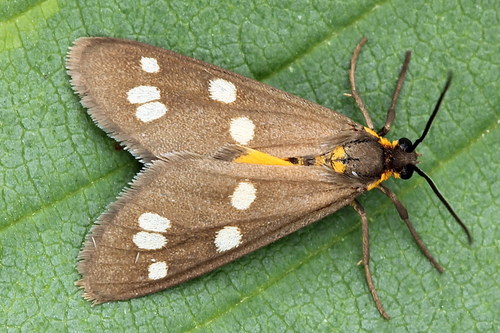
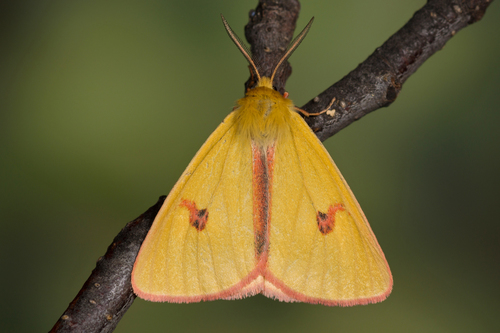
This species, Diacrisia sannio (Linnaeus, 1758), has a wingspan ranging 35–50 mm. Males have lemon yellow forewings and ivory yellow hindwings; both wings bear a greyish red median spot and a pink margin. Females have both their body and wings suffused with brownish red. Several named forms and variations of this species are recognized. The form pallida Stgr. occurs regularly in Central Asia, and occasionally as an aberration in Europe; this form shows reduced black colour. The taxon irene Butl., now treated as the full species Diacrisia irene Butler, 1881, is found in Japan and occurs locally in other parts of the Palearctic region, and Matsumura also classified it as a separate species. For this taxon, males have no black colour on the hindwing, and the forewing median spot is generally reduced. The form uniformis Stgr. (classified as D. s. mortua (Staudinger, 1887)) from Syr-Darja has lost all remaining traces of black and pink colouration; extreme uniformis specimens have entirely uniform pale yellow colour across both sides of the wings and the entire body. Specimens from Ferghana, Issyk-kul, and neighbouring areas further east in Central Asia are classified as the form mortua Stgr. (D. s. mortua (Staudinger, 1887)); in this form, the red inner margin of the forewing is completely absent, while black colouration on the hindwing remains. Further east at the Amur, a form called amuri Butler, 1881 Stgr. occurs with very distinct sharp black markings, and the ground colour of the hindwing is strongly tinged with reddish. Diacrisia sannio is distributed across the Palearctic realm, ranging from Ireland to Siberia, and is not present in North Africa. In the Russian Far East (Amur, Primorye, Sakhalin, Kunashir), eastern China, Korea, and Japan, Diacrisia irene replaces Diacrisia sannio instead.