About Diabrotica undecimpunctata Mannerheim, 1843
Diabrotica undecimpunctata, commonly known as spotted cucumber beetle, is one of three main cucumber beetle types, alongside banded cucumber beetle (Diabrotica balteata) and striped cucumber beetle (Acalymma vittatum). In North America, spotted and striped cucumber beetles are the most commonly encountered varieties. This species has three subspecies, each with a distinct common name: Diabrotica undecimpunctata howardi (spotted cucumber beetle or southern corn rootworm), Diabrotica undecimpunctata tenella (western cucumber beetle), and Diabrotica undecimpunctata undecimpunctata (western spotted cucumber beetle).
Adult Diabrotica undecimpunctata feed on the leaves of many crops, including squash, cucumbers, soybeans, cotton, beans, and corn. Adult females lay eggs in soil near cucurbit plants. A female typically lays 150 to 400 eggs over her lifetime, though some individuals have been recorded laying up to 1,200 eggs. Eggs hatch around mid-spring, taking 6 to 9 days to hatch under favorable conditions. In cooler climates, eggs can take up to 30 days to hatch. Moist soil is ideal for egg survival.
The yellowish, wormlike larval stage lasts approximately 2 to 3 weeks. After the larval stage, the insect enters the pupal stage, which lasts 6 to 10 days. Pupae measure around 6.25 millimeters long and 3.5 millimeters wide. They have a pair of robust spines at the tip of their abdomen, plus smaller spines on the upper side of their other abdominal segments. After the pupal stage, adult beetles emerge.
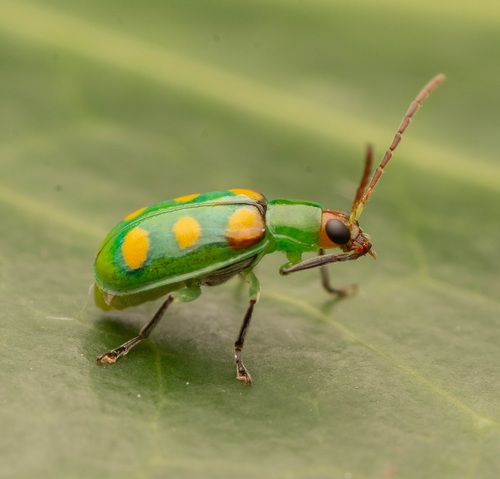
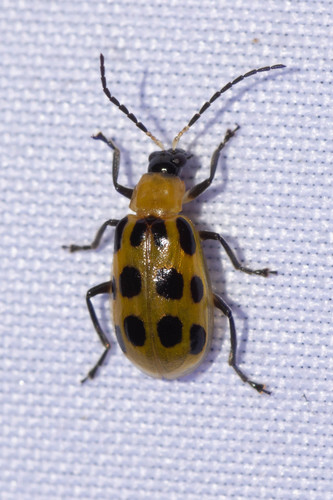
Adult beetles are greenish-yellow, with six large black spots on each elytron, and are about 0.5 centimeters long. Adults usually live 60 days in summer, and can survive up to 200 days in winter. This species is distributed across southern Canada, the continental United States, and the central highlands of Mexico, and is especially widespread across the southern United States.