About Deudorix epijarbas (Moore, 1858)
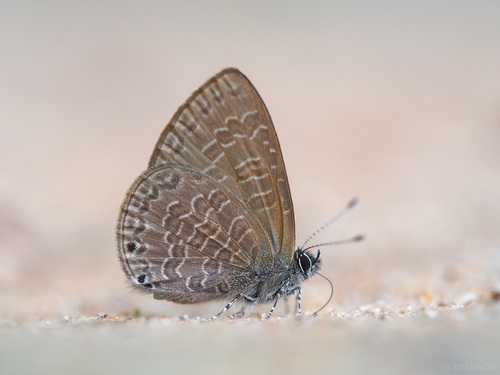
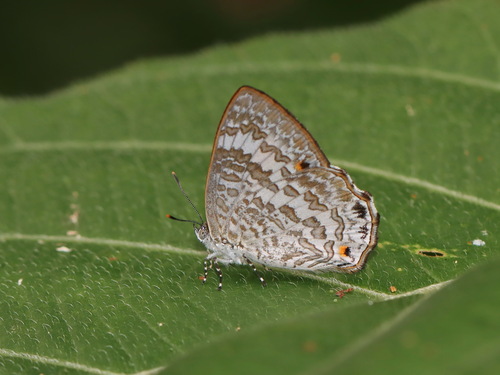
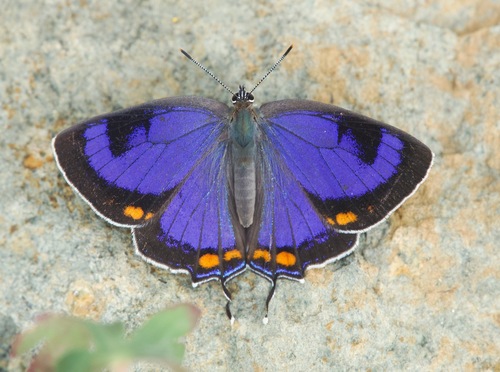
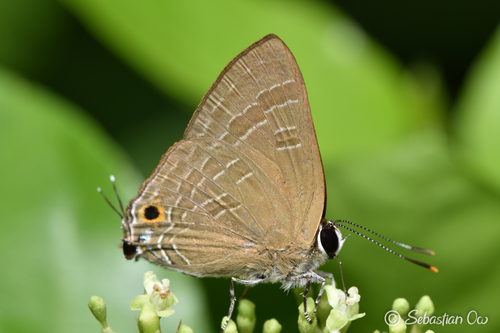
Male: Upperside is scarlet-red. The forewing has broad black costal and outer marginal borders. The inner margin of the costal band is somewhat curved, and is bounded by the median vein, making the band broadest at the apex. The inner edge of the band along the outer margin is uneven; at the hinder angle, the black band extends a short distance along the hinder margin. The rest of the hinder margin and the sub-median vein are narrowly suffused with black. The hindwing has lilackish suffusion on the costa, base, and abdominal area; the abdominal fold is brown, and the outer marginal line is finely black. The anal lobe is black with a small red mark; the tail is black, tipped with white, and the veins are often more or less finely black. Antennae are black, ringed with white; the club has a red tip and a white streak on the underside below the tip. Underside is greyish-brown, with markings defined by white edges. The forewing has a thick bar at the end of the cell, split by a pale white line, plus an almost straight, rather broad discal band that narrows gradually towards the hindward part of the wing, and a sub-marginal series of thick lunular marks edged outwardly with white, whose lower end sits close to the lower end of the discal band. The hindwing has a thick bar with a pale white line running through it at the end of the cell, plus a discal series of seven conjoined spots: the upper six are squarish, the seventh is angled, and the whole series is irregular. The second spot sits a little outwards, the fifth a little inwards, touching the lower end of the spot of the discoidal band. Spots decrease in size hindwards, and the angular spot extends inward onto the abdominal margin one-third above the anal angle. There is a submarginal series of similar spots that increase in size hindwards. The anal lobe is black, with a linear white mark and a curved streak of metallic blue scales above it; there is a black spot in the first interspace, ringed with orange. Female: Upperside is fulvous-brown. The forewing has fulvous suffusion below the median vein, which varies in extent between different individuals. The hindwing has a pale abdominal fold; some individuals have no additional markings, some have the entire wing tinted with fulvous, and some show faint indications of a series of fulvous submarginal spots. Underside matches that of the male, though the ground colour is often much paler. The wingspan of Deudorix epijarbas is about 30 mm. Its larvae feed on the seed capsules of Connarus species, plus Sapindus trifoliatus, Euphoria longan, Litchi chinensis, Aesculus indicus, Harpullia pendula, Pometia pinnata, Caryota rumphiana and Sarcopteryx martyana.