About Dessonornis caffer (Linnaeus, 1771)
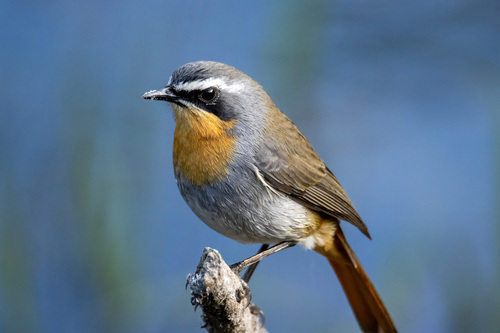
Dessonornis caffer, commonly known as the Cape robin-chat, shows no visible difference between males and females. Adults measure 16–17 cm from bill tip to tail tip and weigh 28 g on average. Adult upper parts are grey, with the mantle and secondary feathers tinged brownish olive. Blackish lores and ear coverts are separated from the crown by a prominent white supercilium. The chin, throat, central breast, rump, upper tail coverts and outer tail feathers are orange. Breast plumage moults to a deeper orange during the non-breeding season. Central tail feathers are greyish-brown, and hide the bright rufous outer tail feathers when the tail is closed. The belly is pale grey to white, and the undertail coverts are buffy. The short, black bill is fairly straight, with a slightly down-curved upper mandible. Legs and feet are black, and the eye is brown. Juveniles have the same tail pattern as adults, but lack a supercilium. They are dark brown above and buff below, with heavy buff markings on the upper parts and grey-brown markings on the breast. Juvenile legs and feet are pinkish grey, and unlike other robin-chats, the soles of their feet are yellow. Immature birds resemble adults but retain some buff-tipped greater wing coverts. This species ranges from South Sudan, mainly in the Imatong Mountains above 1,600 m, southwards through Uganda, the Democratic Republic of the Congo (between 1,800 m and 3,475 m), Kenya, Tanzania, Zambia (above 1,800 m), Malawi (common above 1,500 m), Zimbabwe, Namibia, South Africa, Eswatini and Lesotho. It is a mainly resident breeder in eastern and southern Africa. Some adults and juveniles migrate more than 100 km to lower, warmer regions in winter, where they may coexist with several other species of robin. However, some individuals remain year-round even at high altitudes. It is common for the same pair to hold a breeding territory for five years, and the maximum recorded life span for the species is over 16 years. In southern Africa, the Cape robin-chat is common at Afromontane forest edges, in forest scrub and ravines, fynbos, karoo, plantations, gardens and parks. Most areas with dense cover and scattered trees or song posts are suitable habitat. In dry areas, it is restricted to thickets that border water courses. In southern Africa it occurs from sea level up to 3,000 m in areas where Leucosidea provides cover, and is absent from the arid Karoo and Kalahari. In tropical East Africa, the Cape robin-chat also frequents forest edge and gardens, but is restricted to uplands. It occurs at 1,100 m in the Uluguru Mountains, but is generally found upwards of 1,500 m in Uganda and the rest of Tanzania, and above 1,800 m in Kenya. Tropical races also inhabit bamboo edges, woodland, scrub, tea and coffee plantations, and areas alongside moorland streams associated with giant heather, up to 3,400 m in altitude. Cape robin-chats generally forage close to or on ground level, but will occasionally glean bark and foliage in tall trees. They prefer the cover of vegetation but are not very shy. They catch invertebrates, small frogs and lizards in scrub or on leaf litter. They also pluck fruit and seeds from plants or eat them on the ground. Occasionally they hawk insects in the air, or glean invertebrates from leaves, branches or rocks.