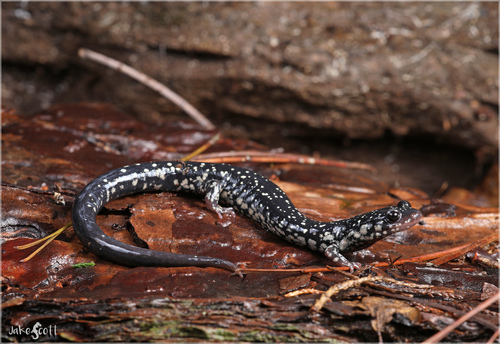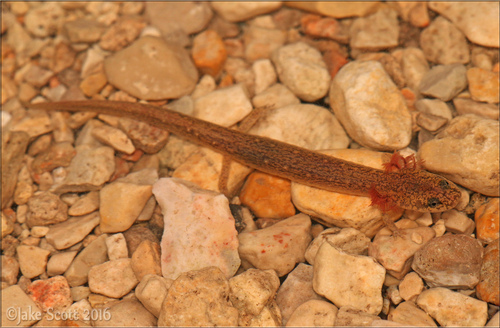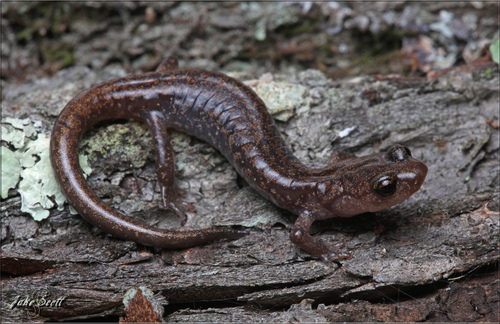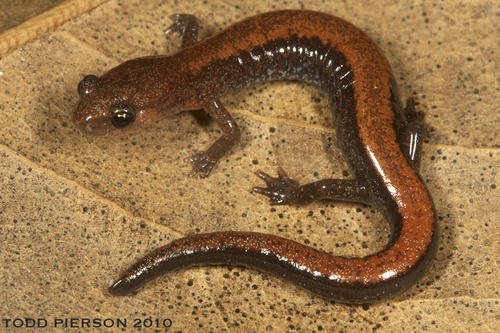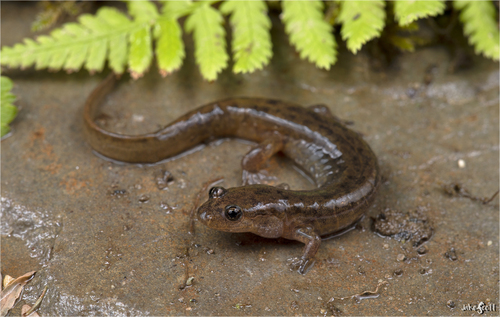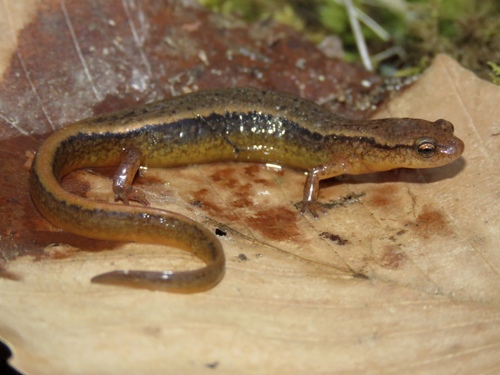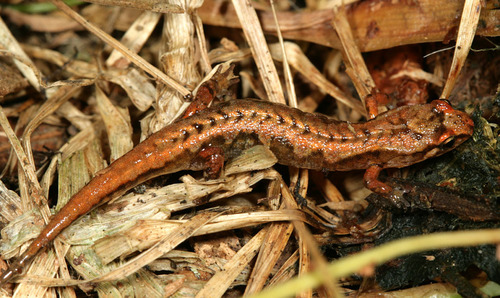
About Desmognathus wrighti King, 1936
Ventral Pattern
Identification: Desmognathus wrighti, commonly called the pygmy salamander, has a light belly with a gold iridophore pattern that extends from the abdomen to the area anterior to the cloacal vent.
Snout and Size
This species has a rounder snout, and total body length ranges from 35–44 mm (1.4–1.7 in); one source notes the species can reach up to 55 mm, but rarely exceeds 50 mm, making it the smallest species in the genus Desmognathus.
Tail Morphology
Its tail is not keeled, and body length is equal to or greater than tail length.
Base Body Color
Pygmy salamanders are most commonly light brown, though body color can range from brick red to yellow.
Dorsal Markings
Dark brown pigment on the dorsal side forms an inverted V-shaped marking running down the back, and this V-shape is a characteristic identifying marking for the species.
Genus-Identifying Stripe
A light stripe running from the eye to the jaw marks this species as a member of Desmognathus.
Dental Morphology
D. wrighti typically has six vomerine teeth on each side of the mouth, in addition to premaxillary and mandible teeth.
Sexual Size Dimorphism
There is no significant difference in maximum size between adult males and females of this species.
Taxonomic Discovery
General description and taxonomy: Desmognathus wrighti was discovered and formally named by King in 1936.
Natural Habitat
The natural habitat of this species includes temperate forests, intermittent rivers, and freshwater springs.
Global Size Context
Its small size places it among the smallest salamanders in the world; adult D. wrighti fall within the size range of the neo-tropical genus Thorius, which are considered the smallest urodeles in the world.
Genus Characteristics
The genus Desmognathus contains 19 species that vary widely in body size, life history, and habitat.
Intragenus Sorting Criteria
The most common way to sort species within this genus is by body size and distance from the streams they inhabit.
2010 Taxonomic Revision Trigger
In 2010, a taxonomic revision of D. wrighti was completed based on genetic and ecological analyses.
Genetic Divergence Basis
DNA sequencing confirmed divergence between two populations separated by the French Broad River, and further research identified additional differences in body type and ventral pigmentation.
Morphological Variation Between Lineages
Ecological niche analysis of the two lineages found significant morphological variation: the lineages differed in snout-vent length, body condition, and head width.
Lineage Distinctness Conclusion
These findings indicated that two distinct, separately evolving lineages were classified under D. wrighti.
New Species Description
The diverging northern lineage was described as the new species Desmognathus organi by Crespi and Browne in 2010.
Revision Rationale
This revision was completed to reflect observed genetic, ecological, and geographic differences between the two populations located north and south of the French Broad River.
Post-Revision Taxonomic Assignment
After the revision, the original D. wrighti described by King now accurately refers to the lineage south of the French Broad River, which matches the morphological descriptions provided here.
Sister Taxon Relationship
D. organi (the northern pygmy salamander) is a sister taxon to D. wrighti.
Morphological Differences From D. organi
D. organi differs from D. wrighti in having a slightly larger body length, wider heads, and an absence of the ventral gold iridophore pattern found in D. wrighti.
D. organi Distribution
D. organi also occurs at higher elevations north of the French Broad River, across Tennessee, North Carolina, and Virginia.
Distribution Fragmentation
Geographical distribution: D. wrighti has a highly fragmented geographic distribution.
Broad Regional Distribution
It occurs in the Southern Appalachian Mountains of North Carolina and Tennessee, south of the French Broad River.
Tennessee Distribution
In Tennessee, this species lives in Great Smoky Mountains National Park in Blount, Cocke, and Sevier counties, as well as in Cherokee National Forest in Monroe County.
North Carolina Distribution
In North Carolina, the pygmy salamander is only documented in Graham County along the Tennessee border.
High Elevation Habitat
The highest abundance of pygmy salamanders occurs at high elevations ranging from 1600 to 2082 meters, where their distribution primarily lies adjacent to red spruce (Picea rubens) and Fraser fir (Abies fraseri) forests.
Elevation Density Gradient
Populations can also be found at lower elevations between 950 and 1400 meters, but the highest population densities occur at higher elevations.
Long-Term Fragmentation Cause
D. wrighti populations have likely remained fragmented for a long time due to their restriction to high elevation habitats.
Low Elevation Population Gene Flow
Documented lower elevation populations show very little gene flow, which reflects this species' preference for higher elevations and possible competition with other Appalachian salamander species.
Microhabitat Preferences
Within its known range, the pygmy salamander is most often found in moist locations such as under logs and rocks along streams, in damp leaf litter, and in mossy areas.
Coloration Reiteration
Ecology: Like the species description notes, D. wrighti is typically light brown, with a pattern of darker brown inverted V-shaped markings along its dorsal side.
Genus Size and Terrestriality
It is the smallest salamander in its genus, and the most terrestrial member of Desmognathus.
Forest Floor Habitat
It is most commonly found in high elevation spruce-fir forests, where it lives in depressions in moss and leaf litter on the forest floor.
Adult Activity Pattern
Adults are active at night, and have been found up to one meter above ground in vegetation.
Reproductive Movement
During summer and early autumn, this species moves to seepages and stream banks to lay eggs.