About Desarmillaria tabescens (Scop.) R.A.Koch & Aime
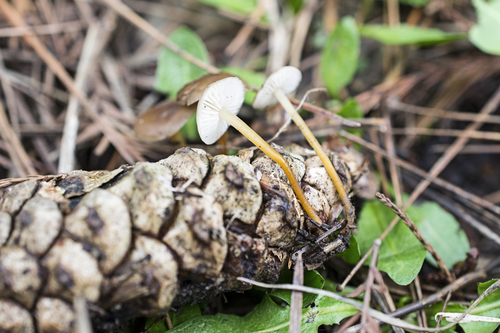
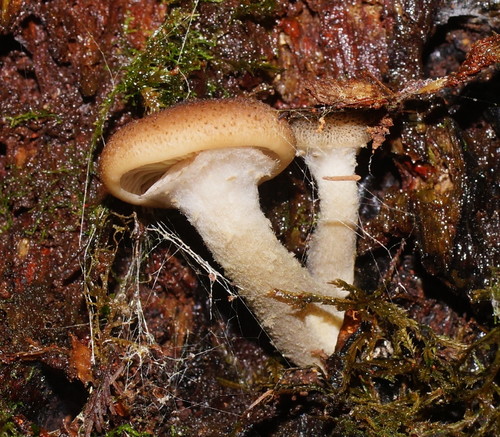
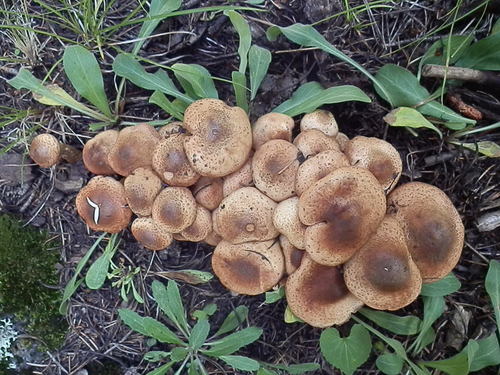
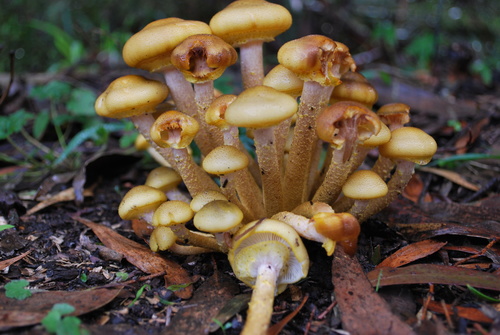
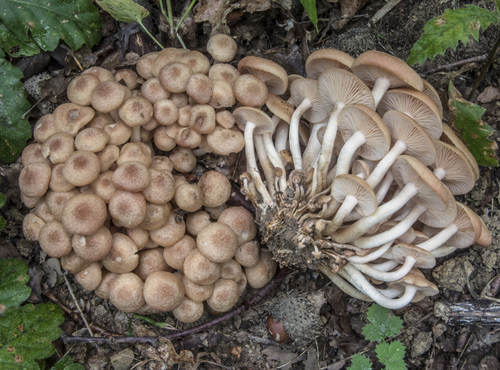
Desarmillaria tabescens, commonly called the ringless honey mushroom and previously known as Armillaria tabescens, is a fungal species belonging to the family Physalacriaceae. It is a plant pathogen, and its mycelium is bioluminescent. This fungus occurs in warm, dry regions, and in Europe it is mostly found in southern areas. Its recorded altitude range spans from sea level up to 1,300 metres (4,300 ft). European surveys have documented it in south-east England, France, Hungary, Italy, Portugal, and Greece; it is rare in Germany and Switzerland. In Japan, the species is very rare: only one isolate was recovered out of 59 surveyed sites. D. tabescens grows quickly at temperatures between 28 and 30 °C (82 and 86 °F), and grows much more slowly at 5 °C (41 °F). Abundant fruiting bodies develop when soil is moist. Compared to Armillaria mellea and Armillaria gallica, D. tabescens is the first of the three to produce fruiting bodies in September. In an exceptionally wet season, fruiting bodies may appear even earlier. This fungus grows poorly on sandy substrates, and produces shorter rhizomorphs. Rhizomorphs are thread-like fungal structures composed of hyphae, which are branching structures that release enzymes to absorb nutrients from a host organism.