About Derobrachus hovorei Santos-Silva, 2007
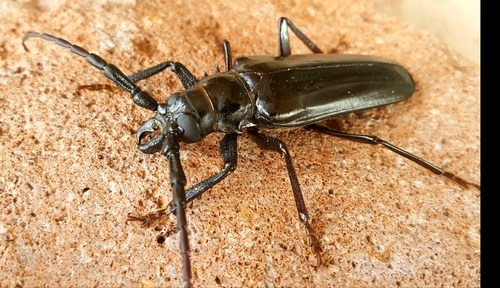
Derobrachus hovorei is a species of beetle in the family Cerambycidae. It has several common names: palo verde beetle, palo verde root borer, and palo verde borer beetle. For more than 100 years, this species was misidentified as the closely related Derobrachus geminatus. It was only recognized as a distinct species and formally named by Santos-Silva in 2007, so nearly all literature published before 2007 incorrectly uses the name Derobrachus geminatus for this beetle. This is a longhorn beetle native to the southwestern United States and northern Mexico. Its common name comes from the palo verde tree. It is one of the largest beetles found in North America, and can grow up to three and a half inches in length. Adult D. hovorei are black or brown, with long antennae and spines on the thorax. They have wings and are capable of flight, though their flight is often awkward. Mature adult beetles emerge during the summer to mate. This species is not harmful to humans, but it can bite in self-defense. D. hovorei hatches from eggs into grubs, which live underground for up to three years. Because of their long underground lifespan, gardeners often uncover these large grubs during routine yard maintenance, especially in flower beds surrounding lawns that host susceptible trees. The larvae are cream-colored to pale green, usually with a brown head. They feed on tree roots, which causes affected tree branches to die back. In the wild, the most commonly affected tree is palo verde, though the species also attacks other wild Parkinsonia species; the most frequent of these are P. florida, P. microphylla, and P. sonorae. In urban areas such as parks, college campuses, and cemeteries, where Parkinsonia species are not commonly grown, D. hovorei can feed on the roots of a wide range of other trees. These include Siberian elm, white mulberry, fruitless mulberry, various cottonwoods, and in the warmest desert regions, citrus trees.