About Dermophis mexicanus (Duméril & Bibron, 1841)
Dermophis mexicanus, commonly known as the Mexican burrowing caecilian, is an amphibian that adults reach 30 to 50 cm (12 to 20 in) in length.
Body Appearance
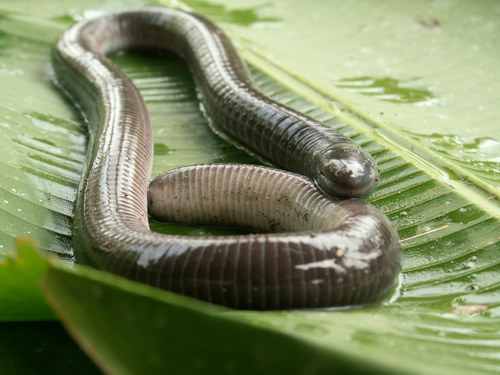
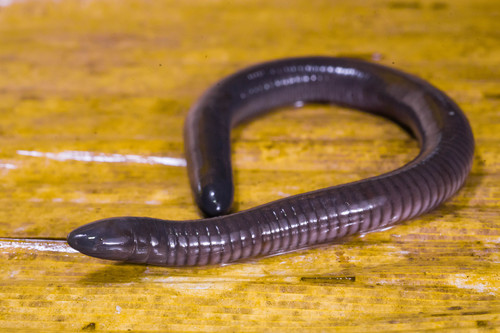
In overall appearance, it looks like a large earthworm. Around a hundred transverse annular folds in its skin create the impression of segmented sections.
Head Features
Its head has a pointed snout, a single row of teeth on the lower jaw, and two vestigial eyes covered by skin; a pair of protrusible tentacles sit between the eyes and nostrils.
Body Structure and Coloration
It has an elongated body with no limbs at all. Its upper body surface is dark grey, while its under surface is pale grey with darker markings on the annular folds.
Geographic Range
This species is distributed across Mexico, Guatemala, El Salvador, Honduras, and Nicaragua, with an unconfirmed presence in Belize. Most populations occur on the Atlantic side of the region, though it also lives in some isolated areas of the Pacific slope.
Habitat Types
Its natural habitats include subtropical or tropical dry forests, moist lowland forests, moist montane forests, plantations, rural gardens, and heavily degraded former forests.
Burrowing Ecology
It is a fossorial species, meaning it burrows and lives underground, occupying damp, loose soil, and also can be found under leaf litter, logs, and plant debris.
Altitudinal Range and Human-Associated Habitats
It is often encountered in banana and coffee plantations, and occurs at altitudes up to 1,200 m (3,900 ft) above sea level.