About Dendryphantes mordax (C.L.Koch, 1846)
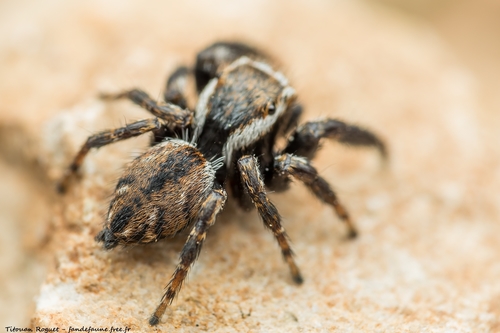
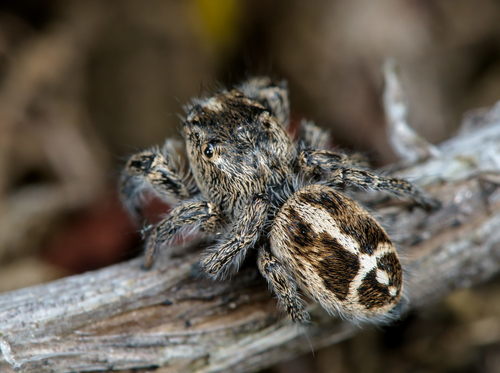
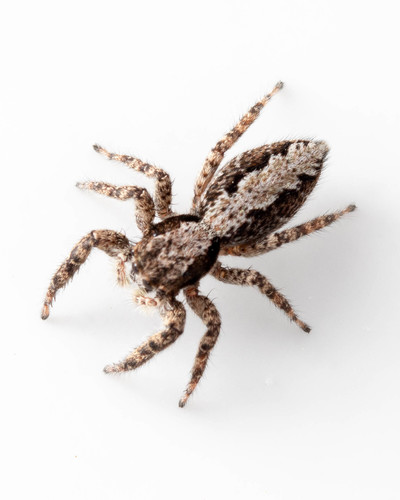
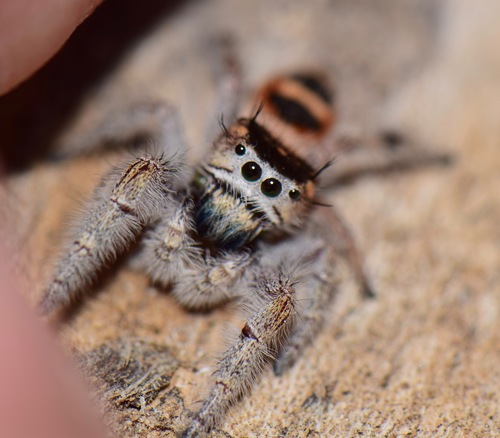
This jumping spider species, Dendryphantes mordax, shows pronounced sexual dimorphism that is typical for jumping spiders. Males have a cephalothorax 2.60 mm long, while female cephalothoraxes measure 2.93 mm long. Females are generally larger than males, and share similar overall body coloration with males, but do not have the distinctive leg coloration that males have. On the female chelicerae, the front margin has two teeth and the rear margin has one tooth. For males, the cephalothorax is dark reddish-brown, with the head region appearing black. Feather-like white hairs form stripes running along each side of the cephalothorax. The narrow clypeus has a light brown fringe. Male chelicerae are mid-brown, with a deeply excavated groove. The front margin of the chelicera has a low blunt bump near its base plus two teeth, and the rear margin has a single robust tooth. The male opisthosoma, or abdomen, has a distinct pattern: it is light brown with a thick dark brown median stripe that branches into four large lateral projections on each side. Broad stripes made of white feather-like hairs run down the center and sides of the abdomen, and these stripes are bordered by golden reflective scales. The male first leg is reddish-brown with a darker tip and a yellow tarsus; all other male legs are light brown, with dark brown markings at the tip of each segment. Dendryphantes mordax is distributed across southern South America, with confirmed records from Chile, Argentina, and Uruguay. In Chile, the species appears to be relatively widespread; specimens have been collected from locations including Pichidigua and Oncol Park. The species has been collected from a variety of habitats, and many specimens were found during bark stripping activities, which suggests the species may live on tree bark and in similar microhabitats.