About Dendrosenecio keniodendron (R.E.Fr. & T.C.E.Fr.) B.Nord.
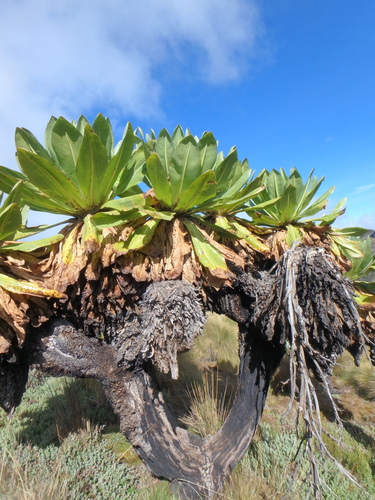
Dendrosenecio keniodendron (R.E.Fr. & T.C.E.Fr.) B.Nord. is a giant rosette plant that occurs at altitudes between 3,900 metres (12,800 ft) and 4,500 metres (14,800 ft). The related species Dendrosenecio keniensis grows in wetter sites, and therefore grows at lower average altitudes, but the ranges of the two species abut, and they occasionally hybridise. Dendrosenecio keniodendron has woody stems that reach up to 8 metres (26 ft) tall and 50 centimetres (20 in) in diameter, with a pith 8 centimetres (3.1 in) in diameter. Stems grow 1 centimetre (0.39 in) to 5 centimetres (2.0 in) per year. The stout stems support 1 to 15 evergreen rosettes at their apex; each rosette is made of 50 to 100 leaves, each measuring 82 centimetres (32 in) long and 22 centimetres (8.7 in) wide. The upper base of the leaf has long, yellowish hairs, which sometimes extend along the upper midvein; the lower leaf surface is hairless or has sparse hairs, with hair density increasing along the lower midvein. Leaf longevity is less than one year. Dendrosenecio keniodendron protects itself against freezing temperatures by closing its leaves when it becomes cold (at night) and opening them when it is warm (during the day); this adaptive insulation method is sometimes called nyctinasty, or a night bud. Older outer leaves freeze, while younger inner meristematic buds remain above the freezing point. A reproductive rosette produces a single terminal flower stalk up to 2 metres (6.6 ft) tall. Flower clusters are loosely branched toward the base, and gradually become simpler toward the tip, reaching 250 centimetres (98 in) tall and 120 centimetres (47 in) in diameter; the flower heads bend downwards. Ray florets are absent; there are 80 to 140 disc florets. Flowers are predominantly wind pollinated. After seed maturation, the original rosette dies, and up to eight new rosettes grow around the base of the flower stalk. Up to five of these new lateral rosettes survive (the typical number is 2 to 3), and each produces a new branch. Each flowering episode therefore creates new forks in the stem. Branching only occurs after flowering, so it provides a record of past reproduction. These branching patterns suggest that plants seldom reproduce more than 4 times before dying. Flowers produce plumed achenes which are dispersed by wind. Reproduction occurs synchronously across the entire population on Mount Kenya, at intervals of 5 to 29 years, which makes Dendrosenecio keniodendron a mast year species. In the alpine zone of Mount Kenya, Dendrosenecio keniodendron is the dominant woody species. It forms dense stands with evenly sized and evenly aged individuals, and nearly closed canopies. Taller stands tend to support a community of shrubs from the genus Alchemilla: Alchemilla argyrophylla and Alchemilla johnstonii. Shorter stands support grasses from the genera Festuca and Carex: Festuca pilgeri and Carex monostachya, which resemble each other and have perhaps often been misidentified. Also found in these communities are pairs of species from three genera: from Poa, Poa schimperi and Poa leptoclada; from Cerastium, Cerastium octandrum and Cerastium afromontanum; and from Erica, Erica timera and Erica arborea. Dendrosenecio keniodendron is endemic to valley slopes and ridges in the alpine zone of Mount Kenya, located at 0 degrees latitude, where it grows at altitudes between 3,700 metres (12,100 ft) and 4,500 metres (14,800 ft).