About Dendrophylax lindenii (Lindl.) Benth. ex Rolfe
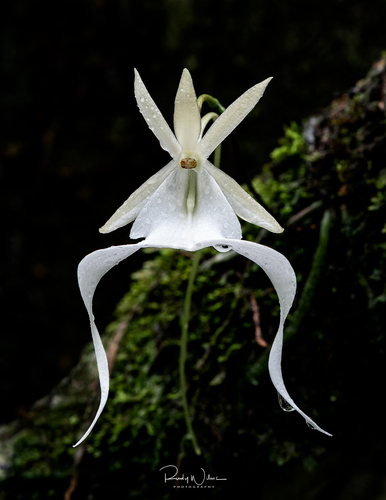
Dendrophylax lindenii, commonly called the ghost orchid (a name also shared by Epipogium aphyllum), is a rare perennial epiphyte in the orchid family Orchidaceae. It is native to Florida and Cuba. Other common names for this species are palm polly and white frog orchid.
The fig sphinx moth, Pachylia ficus, was the first insect scientifically documented to pollinate Dendrophylax lindenii. This discovery overturned long-held hypotheses that claimed the giant sphinx moth Cocytius antaeus was the only possible pollinator. Based on this new finding, current research suggests nearly a dozen hawkmoth species (family Sphingidae, order Lepidoptera) could also act as potential pollinators in Florida, with even more potential pollinator species present in Cuba.
Dendrophylax lindenii can be successfully cultivated in terrarium-like environments. Plants are mounted bare-root on decay-resistant, untreated wooden stock, which is placed horizontally on top of a bed of living sphagnum moss. This setup meets the species' requirement for high humidity and stagnant air; Wardian cases or greenhouses can also approximate these growing conditions. Plants have been observed to thrive particularly well on hickory wood over 100 years old.
Plants should not be allowed to pollinate and set seed unless they are very large, at least 250 mm (10 in) across. Plants without sufficient biomass will put all their stored reserves into producing a very large seed pod, then behave like an annual and die after setting seed.
These plants should receive weekly applications of 1⁄4-strength fertilizer mixed into distilled or other low-salt water. They are intolerant of water with high levels of dissolved salts, which causes roots to die starting from the tips. Continued exposure to chlorinated tap water usually kills these plants: root tips turn yellow and rapidly die back to the plant's reduced stem. It is normal for plants to periodically break down and shed older roots; this process does not turn roots yellow. Instead, older roots simply shrivel, turn gray, and then detach completely. Healthy plants have vigorous, actively growing lime green root tips. Root tips grow continuously given bright light, regular fertilization, and regular watering, with only a short resting period in late fall or early winter.
Water should never be allowed to pool around the roots, and no portion of the plant's roots should be immersed in standing water for any extended period of time. To encourage quick growth in young, small plants, keep roots continuously moist without allowing standing water, and apply fertilizer regularly. If small plants' roots dry out, growth stops almost entirely. Keeping plants consistently moist (but not wet) stimulates biomass gain and active root growth when plants are young. The roots of these plants often produce new plantlets in a starfish-like pattern. New plantlets form from broken or damaged roots, or from roots longer than 300 mm (12 in); this growth habit is shared with other members of the genus Dendrophylax.
While wild plants occasionally experience light frost that causes minor root tip damage, cultivated plants should generally never be exposed to freezing temperatures. Except for very short exposures, freezing will kill cultivated Dendrophylax lindenii.
Flowering is triggered when large plants (typically with a root mass 180–200 mm, or 7–8 in, across, large enough to support blooming) experience a cool, dry resting period over several months in late fall and early winter. During this resting period, plants receive only very light misting every few weeks, and growing humidity is lowered. Newly forming flowers emerge from the highly reduced stem at the center of the root mass, and cannot be easily distinguished from aerial roots until flowers begin to develop. Once new growth becomes visible after the resting period, normal watering can resume.
Large plants that have set seed pods need more frequent fertilizing. Growers should limit plants to just one seed pod by removing all other immature seed pods. When attempting to produce seed pods, if the plant has multiple flowers, all flowers should be hand pollinated with pollinia from a different plant if available, and only one seed pod should be left on the plant, since not all pollination attempts will succeed. When mature, the seed pod holds thousands of microscopic, dust-like seeds.
In its natural habitat, successful pollination of Dendrophylax lindenii is an infrequent but not rare event. Wild plants also flower irregularly, and do not flower at all in some years.