About Dendrocygna guttata Schlegel, 1866
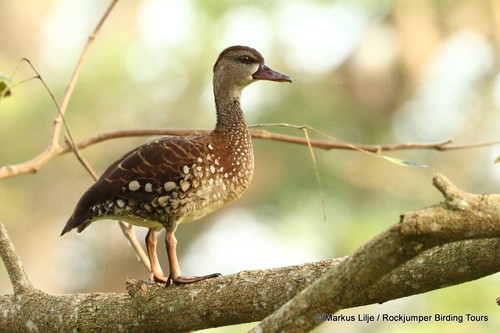
The spotted whistling duck (Dendrocygna guttata Schlegel, 1866) is one of the smaller species in the genus Dendrocygna. Adults reach 43–50 cm in length. Males weigh between 590 g and 650 g, while females weigh between 610 g and 860 g. The species gets its common name from the white spots that appear on its flanks and breasts. The sides of the neck, face, and eyebrows are all grey. Black or dark brown colouring extends from the crown and nape to the hindneck, and this dark colour is also present on the eyepatch. The bird's body colour pattern resembles a cape with a thick collar; this cape starts as light brown and fades to a darker brown closer to the tail. The underbelly is mostly brown, sometimes spotted, and is noticeably lighter than the wings and the "collar". A white bar on the upper tail coverts is visible during flight and helps identify the species. It has dull pink legs, black webbed feet, and sharp nails. Its bill is dark, but often has portions of red, plus a small white mark on the lower mandible. Spotted whistling ducks hold themselves in an upright position, as if standing tall off the ground. Their wings are held tightly against the body. The inner vanes of the outer primaries are jagged, and this can be seen in flight. When flying, the head is positioned downward, which makes the whole bird look hunched. The tail remains pointed and appears long during flight. Juveniles have white streaks on their flanks instead of spots, and have much duller overall colouring. The spotted whistling duck looks very similar to D. arborea, though many scientists consider its closest relative to be D. eytoni. After developing adult plumage at 6 months of age, the spotted whistling duck has one annual molt. Like other anseriforms (ducks, swans, and geese), the spotted whistling duck molts synchronously. Synchronous molting is common in Anseriformes because waterfowl are able to avoid terrestrial predators: unlike other birds, waterfowl float safely in ponds and lakes while molting. While more evolved ducks have two molts per year, whistling ducks only molt once. While whistling ducks as a group are found all over the world, the spotted whistling duck is distributed across the Philippines, Australia, and New Guinea. It lives in the southern Philippines and on several islands of Indonesia, where its range extends from the Eastern Lesser Sunda Islands to New Guinea. In Australia, it occurs in Weipa and the Iron Range, and has also been recorded at Wonga Beach. Scientists hypothesize that the Indonesian population was introduced after a storm blew the birds off course. Like many other ducks, spotted whistling ducks live near bodies of water. They specifically occur around small ponds and marshes surrounded by trees, and prefer humid, low-altitude habitats. They nest in hollows of the trees that surround their habitats.