About Dendrocygna bicolor (Vieillot, 1816)
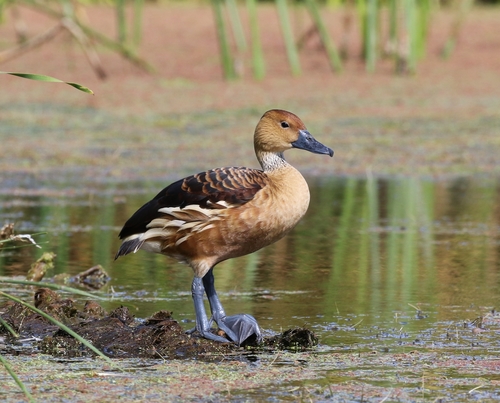
The fulvous whistling duck (Dendrocygna bicolor (Vieillot, 1816)) measures 45–53 cm (18–21 in) in length. Males weigh 748–1,050 g (26.4–37.0 oz), while females average slightly lighter, at 712–1,000 g (25.1–35.3 oz). Its wingspan ranges from 85 to 93 cm. This is a long-legged duck, primarily colored in different shades of brown. Its head, neck, and breast are a particularly rich buff (fulvous) tone, with a darker back. The mantle is a darker shade of brown, with buff-tipped feathers; flight feathers and the tail are dark brown, and a dark brown to black stripe runs from the center of the crown down the back of the neck to the base of the mantle. It has whitish stripes on its flanks, a long grey bill, and grey legs. In flight, the upper surface of the wings is brown and the lower surface is black, with no white markings, and a white crescent on the rump contrasts with the black tail. All plumages are fairly similar, but females are slightly smaller and have duller plumage than males. Juveniles have paler underparts and are generally duller overall, especially on the flanks. After breeding, fulvous whistling ducks undergo a complete wing moult, and seek cover in dense wetland vegetation while they are flightless. Body feathers may be moulted throughout the year, and each individual feather is replaced only once annually. These are noisy birds, with a clear whistling kee-wee-ooo call given when on the ground or in flight, and frequently heard at night. Birds quarrelling also produce a harsh repeated kee call. In flight, their beating wings make a dull sound. Male and female calls differ in structure, and an acoustic analysis of 59 captive birds achieved 100% accuracy in sexing when compared to molecular methods. In Asia, adult fulvous whistling ducks can be confused with the similar lesser whistling duck, which is smaller, has a blackish crown, and does not have an obvious dark stripe down the back of the neck. Juvenile fulvous whistling ducks are very similar to young lesser whistling ducks, but crown color still provides a distinction. Juvenile comb ducks are bulkier than whistling ducks and have a dark cap on the head. In South America and Africa, juvenile white-faced whistling ducks can be distinguished from fulvous whistling ducks by their dark crowns, barred flanks, and chestnut breasts. The fulvous whistling duck has a very large range spanning four continents. It breeds in lowland South America from northern Argentina to Colombia, and extends north to the southern United States and the West Indies. It occurs across a broad belt of sub-Saharan Africa, and down the eastern side of the continent to South Africa and Madagascar. The Indian subcontinent is the species' Asian stronghold. It makes seasonal movements in response to water and food availability. African birds move south to breed in the southern summer, and return north in the winter, while Asian populations are highly nomadic due to variable rainfall. This species has strong colonizing tendencies, and has expanded its range in Mexico, the United States, and the West Indies in recent decades. It expanded north into California in the late 19th century, and into rice-growing regions of the U.S. Gulf Coastal Plain in the early to mid-20th century, reflecting the species' affinity for rice-growing areas. In northern America, breeding is restricted to the Gulf Coastal Plain of Texas and Louisiana, plus localities in southern California, and south- and east-central Florida. Outside the nesting season, observations of the species, especially since the 1950s, have been recorded in temperate regions as far north as the Mississippi River Basin, the eastern Great Lakes region, and along the Pacific and Atlantic Coasts all the way to southern Canada. Wandering individuals can appear far outside the species' normal range, and sometimes stay to nest, as recorded in Morocco, Peru, and Hawaii. The fulvous whistling duck inhabits lowland marshes and swamps in open flat country and rice fields, and avoids wooded areas. It is not normally a mountain species: for example, in Venezuela it only breeds up to 300 m (980 ft), but the single recorded breeding event in Peru was at 4,080 m (13,390 ft).