About Dendroctonus valens LeConte, 1859
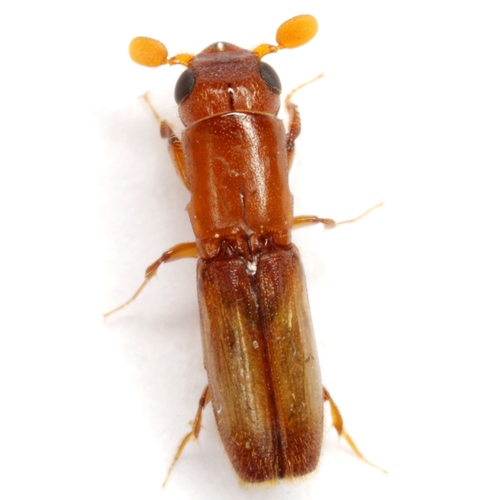
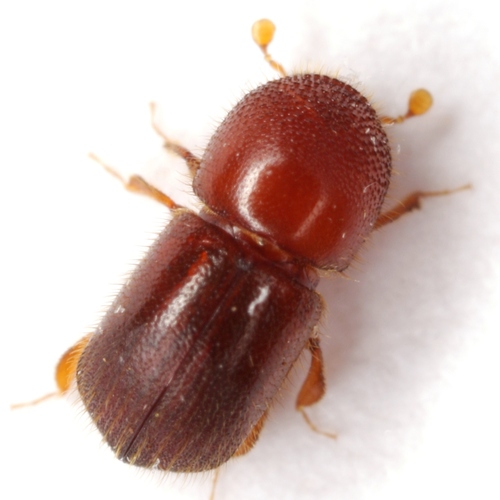
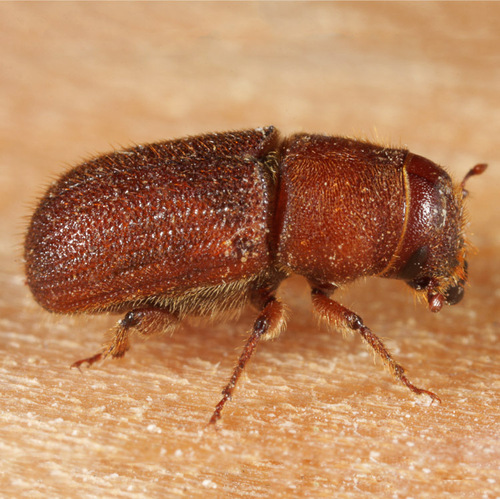
Dendroctonus valens LeConte, 1859 is an insect species with distinct life stage morphology. Its eggs are cylindrical with rounded ends, white, opaque and shiny, measuring about 1 mm (0.04 in) long. The larva is a white, legless grub, with a brown head and a brown-tipped abdomen. As the larva grows, lateral rows of pale brown tubercles become visible. A fully grown larva is 10 to 12 mm (0.39 to 0.47 in) long. The pupa is white and exarate, meaning its antennae and legs are free and not enclosed in a cocoon. The adult beetle is 6 to 10 mm (0.24 to 0.39 in) long, and its body is approximately twice as long as it is wide. When it first emerges from the pupa, the adult is tan, but it quickly darkens to a reddish-brown color.
This species is naturally distributed across North and Central America. Its native range stretches from Canada, and the northern and western United States, south to Mexico, Guatemala and Honduras. In the mid-1990s, it was accidentally introduced into China, most likely in imported wood packaging material, where it became established. A major outbreak occurred in Shanxi Province in 1999, and the species has since spread to Hebei, Henan and Shaanxi Provinces. It has a broad potential host range that could allow it to spread to other regions of China and more widely across Eurasia.
In its native North America, this bark beetle attacks white fir (Abies concolor) and various species of spruce (Picea) and pine (Pinus). In China, it mainly attacks Manchurian red pine (Pinus tabuliformis), and occasionally attacks Chinese white pine (Pinus armandii). On tree stumps or recently dead trees, the presence of these beetles is marked by frass they produce mixed with dried resin, forming visible structures called "pitch tubes". Pitch tube color varies by beetle species within this family. Infected living trees show shortened needles that do not stay attached well, stunted growth, a sparse crown, and dead branches. The needles also change color progressively, shifting from green to yellowish-green, yellow, chestnut, and finally red; at this final red stage, the tree is classified as dead.
In the southern parts of D. valens' geographic range, the species can be active year-round, with multiple generations coexisting in a single population. Further north, the beetles are active from May to October, and only produce one generation per year; in these northern regions, larvae can take more than a full year to reach maturity. On living host trees, beetles excavate an entry hole within one to two meters above ground level. After successfully reaching the cambium layer, a mated pair mates, and the female digs a vertical gallery. She lays her eggs in small clusters on one side of this gallery. The beetles continue expanding their galleries while the eggs incubate. When the eggs hatch, the larvae dig out a large communal gallery in the phloem and cambium, which becomes filled with frass. After two months or more, when development is complete, the larvae pupate in individual cells inside the main chamber, or in short side galleries. Development rate depends on environmental temperature. Galleries can extend from the lower sections of tree trunks up into the upper root system, and beetles in northern regions move into roots to hibernate during the winter. When warmer spring weather arrives, the beetles bore out of the trunk and disperse, locating suitable new host trees by detecting ethanol, monoterpenes, and pheromones.
In China, Dendroctonus valens mostly completes development to its adult form over the winter. Its dispersal period runs from mid-April to mid-May, when the beetles seek out and infest new host trees. Infestation relies on a pheromone-mediated mass attack strategy, which is necessary to overcome the host tree's natural defenses. After the tree's defenses are breached, the beetles shift from emitting aggregation pheromones that attract more conspecifics to releasing anti-aggregation pheromones. This shift prevents over-colonization, which would cause overexploitation of the host tree's resources. After successful colonization, female beetles begin the reproductive stage, laying eggs in purpose-built egg chambers inside the tree's phloem. Larvae feed on the phloem layer and complete all developmental stages inside the protected tree. The life cycle ends in fall, when mature larvae pupate and emerge as adults from the pupal chambers. These new adults overwinter, and then begin the cycle again the following spring.