About Dendroctonus terebrans (A.G.Olivier, 1800)
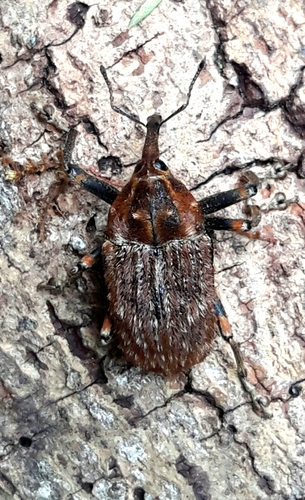
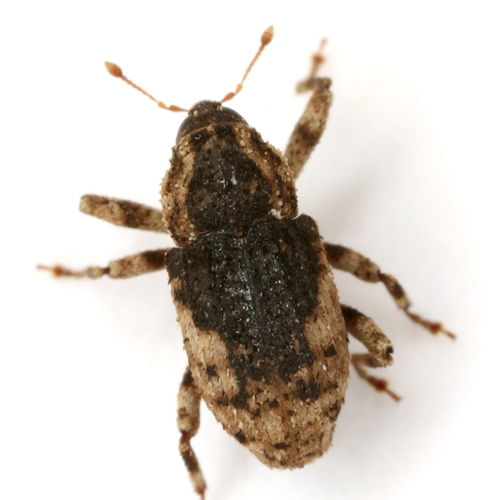
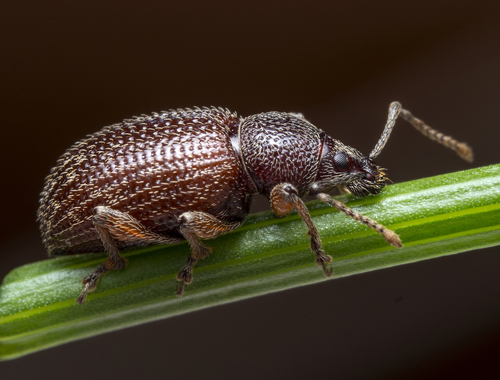
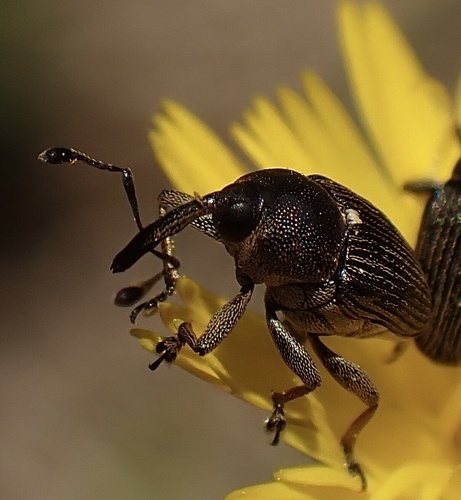
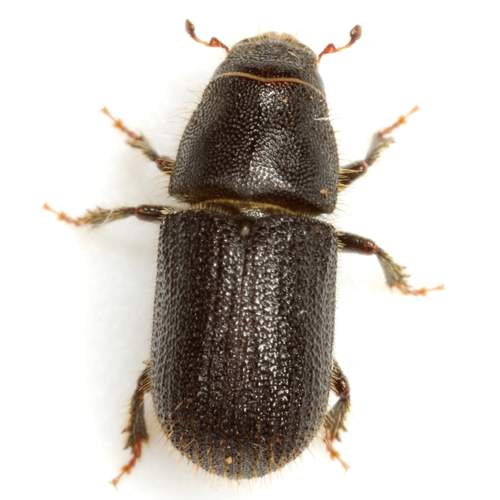
Dendroctonus terebrans, commonly called the black turpentine beetle, is the largest bark beetle found in the southeastern United States. Adult beetles measure 5 to 8 mm (0.2 to 0.3 in) in length, have a cylindrical body shape, and range in color from dark reddish-brown to black. Their prothorax is narrower at the front than at the back and does not fully cover the head. Their antennae are club-shaped, the front of the head is convex, and the tip of the abdomen is rounded. Fully developed larvae are creamy-white with orange-brown heads, lack legs, and reach approximately 12 mm (0.5 in) in length. This species is native to the eastern United States, where it attacks both native and exotic pine species. Its range extends from New Hampshire south through the coastal plain to Florida, and west to Texas and Missouri. The related red turpentine beetle (Dendroctonus valens) has a much broader distribution across the eastern United States, and the ranges of these two species overlap very little. Dendroctonus terebrans is strongly attracted to volatile chemicals produced by freshly cut pine stumps, and it infests both these stumps and intact trees, with a particular preference for stressed trees. Infested trees are often attacked at the same time by engraver beetles of the genus Ips and the southern pine beetle (Dendroctonus frontalis). This beetle attacks pine trees near their base. A female beetle tunnels through the bark and must overcome resin exuded by the tree as a defensive response. This oozing resin mixes with wood dust to form a pinkish "pitch tube" on the bark at the entry site. If the female successfully reaches the sapwood, she spends about two weeks excavating a gallery that typically starts horizontally before turning vertically downward, often extending below ground level. After gallery construction, a male joins the female, and she lays roughly 100 eggs along one side of the gallery. Eggs hatch 10 to 14 days after being laid, and the larvae fan out to chew side-by-side through the surface layers of the sapwood. They create a gallery that becomes packed with the frass they produce. This gallery structure resembles those formed by three related species: the pine-feeding red turpentine beetle and Mexican bark beetle (Dendroctonus rhizophagus), and the spruce-feeding great spruce bark beetle (Dendroctonus micans). Once development is complete, the larvae tunnel away from each other individually to create separate pupation chambers, where they pupate. When adults finish developing, they drill through to the bark surface and disperse. In Florida, breeding occurs year-round, and there may be three overlapping generations. This beetle can act as a vector for blue stain fungus, carrying the pathogen between trees. A European predatory beetle, Rhizophagus grandis, which normally preys on the related great spruce bark beetle, has been found experimentally to be attracted to the frass produced by black turpentine beetle larvae. Biological control of Dendroctonus terebrans using this predator is under investigation, and a batch of these predatory beetles imported from Belgium was released in Louisiana in 1988.