About Dendroctonus rufipennis Kirby, 1837
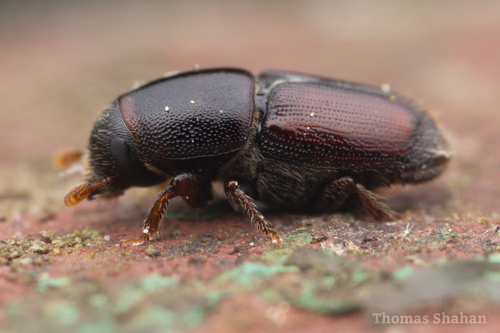
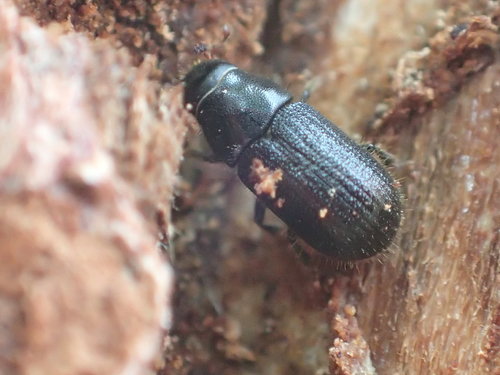
Dendroctonus rufipennis Kirby, 1837, commonly known as the great spruce bark beetle, is a species of bark beetle native to British Columbia, Newfoundland and Labrador, Nova Scotia, Ontario, Quebec, Northern Manitoba, the Yukon, Alaska, Colorado, Wyoming, Montana, and Maine. This transcontinental North American species can cause serious damage to spruce tree forests, including forests of Engelmann spruce, White spruce, Sitka spruce, and Colorado blue spruce. Adult great spruce bark beetles average 4 to 7 mm in length, making it one of the larger bark beetle species found on spruce. White spruce and Engelmann spruce are its principal host trees. The beetles are strongly attracted to blowdowns, cull logs, and freshly-cut logs. Outbreaks of this beetle have been devastating to white and Engelmann spruces across western North America, ranging from Arizona to Alaska, while smaller outbreaks have occurred in Alberta and Saskatchewan. This species is the most serious pest of mature and overmature spruce in Alberta and British Columbia. Small-diameter, rapidly growing trees are least susceptible to attack or death from the beetle. Large-diameter, slowly-growing trees have greater susceptibility, which is more closely linked to recent radial growth than to trunk diameter, so measures that maintain healthy radial growth rates offer the most effective defense against infestation. Initial attacks on the lower trunk are visible as red boring dust in bark crevices and pitch tubes, especially when attacking weakened or recently dead trees. Overwintering adults build egg tunnels for their first brood in June, and create a second set of tunnels for a second brood in late July. Some individuals from the first brood emerge as adults in late July and build additional tunnels, while others overwinter as mature larvae and emerge as adults in July, alongside another segment of the population that overwintered as early larvae. This species can have a 1-, 2-, or 3-year life cycle, with the 2-year cycle being the most common. In the 2-year cycle, the flight and attack period begins in June, or shortly after most snow around host trees has melted. Adults create approximately 6 galleries per 929 cm² in the inner bark; each gallery is around 12.5 cm long and runs parallel to the grain of the wood. Females lay 3 to 4 groups of eggs along the gallery sides, with roughly 100 eggs per gallery. Eggs hatch after 3 to 4 weeks. By the start of the dormant season, larvae range in size from one-quarter grown to fully mature. They resume development the following June, pupate during summer, and develop into the adult stage in late summer or early fall. Most adults emerge from the tree, fall or crawl to the ground, and re-enter the same tree to hibernate, often clumping together under the bark. They emerge the following spring and fly to live green trees, blowdowns, cull logs, or stumps to start a new generation. A 1-year life cycle may occur at lower elevations, on warmer sites, or during abnormally warm years, when individuals reach the adult stage before winter begins. A 3-year life cycle occurs at high elevations, on cold sites, or during unseasonably cold years. The blue stain fungus Leptographium abietinum can worsen the damage caused by these beetles. Dendroctonus rufipennis and Polygraphus rufipennis both carry this fungus, along with other fungal species. When inoculated onto white spruce seedlings, Leptographium abietinum killed 71% of tested seedlings, while the other fungi carried by the beetles caused no seedling mortality.