About Dendrocolaptes sanctithomae (Lafresnaye, 1852)
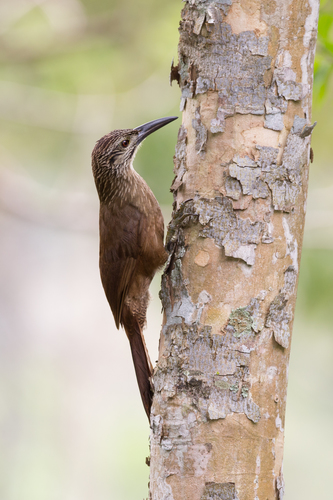
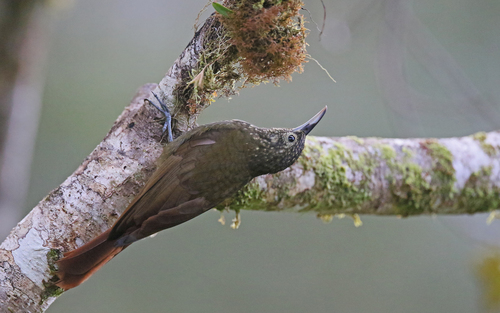
The northern barred woodcreeper (scientific name Dendrocolaptes sanctithomae, first described by Lafresnaye in 1852) is one of the larger species in its subfamily. It has a slim build, a long tail, a medium-length straight bill, and males possess a shaggy crest. The species measures 25 to 29 cm (9.8 to 11 inches) in total length; males weigh 53 to 72 g (1.9 to 2.5 oz) and females weigh 54 to 83 g (1.9 to 2.9 oz). The sexes have identical plumage. For adults of the nominate subspecies D. s. sanctithomae, the face is mostly cinnamon-brown with fine barring, with a faint rufous supercilium, black lores, and a rich rufescent forehead, crown, and nape. The back and wing coverts are olive-brown, while the rump and tail range from cinnamon-rufous to rufous-chestnut. Black barring marks the crown and back. Flight feathers are also cinnamon-rufous to rufous-chestnut, with dusky tips on the primaries. The chin, throat, and underparts are golden to cinnamon-buff with narrow, well-defined black barring. The iris is light to dark brown, the bill is mostly blackish with paler edges and a paler base to the mandible, and leg and foot color varies among dark brown, black, grayish green, bluish, and horn. Juveniles resemble adults but have more diffuse underpart barring, redder undertail coverts, and an entirely black bill. Compared to the nominate subspecies, D. s. sheffleri has sparser barring on the upperparts, narrower barring on the underparts, and a grayish tinge on the lower breast that contrasts with the more yellowish color of the rest of the underparts. D. s. hesperius is duller overall than the nominate, with weaker barring on the upperparts and finer barring on the underparts. D. s. punctipectus is mostly brown with dusky barring, except for mottling on the chin and throat; it also has rufous-chestnut lower back, wings, and tail, and a heavier, entirely brownish black bill compared to the nominate. The four subspecies of the northern barred woodcreeper have separate ranges: D. s. sheffleri is found on the Pacific slope of Sierra Madre del Sur in southwestern Mexico. D. s. sanctithomae occurs on the Caribbean slope from Veracruz and the Yucatán Peninsula in Mexico, south through Belize, Guatemala, Honduras, Nicaragua, and Costa Rica into Panama; it also occurs on the Pacific slope from Chiapas, Mexico, south intermittently through Guatemala, El Salvador, Honduras, Nicaragua, Costa Rica, Panama, and northern and western Colombia into northwestern Ecuador. D. s. hesperius is found on the Pacific slope of southwestern Costa Rica and western Panama. D. s. punctipectus occurs in northern Colombia from the Magdalena River valley east into northwestern Venezuela (note that the published map excludes this subspecies' range). The northern barred woodcreeper primarily inhabits humid tall evergreen forest. It also occurs in shorter forest, gallery forest, semi-deciduous forest, and mangroves, and less frequently in cloudforest and pine-oak woodlands. It favors forest interior, but is regularly found at forest edges, in mature secondary forest, and in plantations located near natural forest. It is mostly a lowland species, most frequently found below 1,000 m (3,300 ft) in elevation. It reaches only 800 m (2,600 ft) in Ecuador, but occurs as high as 1,800 m (5,900 ft) in northern Central America, 1,300 m (4,300 ft) in Costa Rica, and 1,200 m (3,900 ft) in Colombia.