About Dendrocolaptes picumnus Lichtenstein, 1820
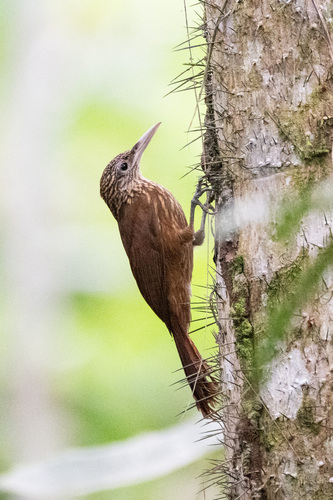
The black-banded woodcreeper (scientific name Dendrocolaptes picumnus Lichtenstein, 1820) is one of the larger species in its subfamily. It has a slim build, a long tail, and a medium-length straight bill. It measures 24 to 30.5 cm (9.4 to 12 in) in length. Males weigh 47 to 89 g (1.7 to 3.1 oz), while females weigh 48 to 98 g (1.7 to 3.5 oz). The sexes have identical plumage. For the nominate subspecies D. p. picumnus, adults have a dusky face and neck with buffy to tawny streaks, a faint supercilium, and an eyering. Their forehead, crown, and nape are dark brown, with buff to tawny streaks on the crown and nape. Their back, scapulars, and wing coverts are olive-brown; the back has fine pale streaks and faint dark bars, and the coverts have pale streaks and dark bands near their ends. Their rump, wings, and tail are rufous-chestnut, with dusky tips on the primaries. Their throat is whitish to deep buff with faint streaks or mottling. Their breast is olive-brown with bold buff streaks and an underlayer of spots or bars. Their belly, flanks, and undertail coverts are buffy brown with strong black bars, and their underwing coverts are a brighter buffy brown with blackish bars. Their iris is dark brown; their bill is black with lighter edges and base to the mandible; and their legs and feet are brown to greenish gray. Juveniles are similar to adults but have fluffier plumage, bolder streaks and bars on the upperparts, weaker barring on the underparts, and a darker crown that is more spotted than streaked. Other subspecies differ from the nominate and from each other as follows: D. p. puncticollis has a blackish crown with fine streaks, narrow streaks on an otherwise clear breast, and fewer bars on the belly. D. p. seilerni, compared to puncticollis, has a browner crown and more streaking on the breast. D. p. olivaceus is similar to seilerni but has more olivaceous underparts, a lighter brown crown, stronger streaks on the back, and buffier streaks on the crown and breast. D. p. multistrigatus is smaller, with fainter streaks above, finer bars below, and more but narrower streaks on the breast. D. p. costaricensis is similar to multistrigatus but has more bars and spots and fewer streaks on the underparts. D. p. validus has no barring on the upperparts or breast, a brownish maxilla, and a paler mandible. D. p. transfasciatus has a blackish crown, bold golden streaks on the upperparts and white streaks on the underparts, weak barring on the back and wing coverts, and a spotted rather than barred belly. D. p. pallescens has more rufescent crown and breast with little to no streaking, the rest of the underparts are bright rusty to plain brown, with indistinct bars on the belly, and a pale olive to bluish horn bill. D. p. casaresi is similar to pallescens but is slightly larger with a longer bill. Subspecies of the black-banded woodcreeper are distributed across three groups as follows: "Spot-throated" group: D. p. puncticollis occurs sporadically in the highlands of Chiapas, central Guatemala, Honduras, and north-central Nicaragua. D. p. seilerni is found in the foothills and highlands of northern Colombia's Sierra Nevada de Santa Marta and the Venezuelan Coastal Range. D. p. olivaceus is found on the eastern foothills of the central Bolivian Andes. "Black-banded" group: D. p. costaricensis is found in the highlands of central and southeastern Costa Rica and the Pacific slope of western Panama. D. p. multistrigatus is found in the Andes and Sierra de Perijá of Colombia, and in northwestern and western Venezuela. D. p. validus inhabits the western Amazon Basin in southeastern Colombia, eastern Ecuador and Peru, northern Bolivia, and western Brazil east to the Rio Negro and Rio Madeira and south to Mato Grosso. D. p. picumnus (nominate) inhabits the northern Amazon Basin of southern and eastern Venezuela, the Guianas, and northern Brazil between the Rio Negro and the Atlantic Ocean in Amapá state. D. p. transfasciatus is found in the lower Amazon Basin of Brazil between the Rio Tapajós and Rio Xingu and south to Mato Grosso. "Pale-billed" group: D. p. pallescens inhabits the Gran Chaco of eastern Bolivia, southern Brazil, and western Paraguay. D. p. casaresi is found in Andean foothills in northwestern Argentina's Jujuy, Salta, and Tucumán provinces. The black-banded woodcreeper lives in a very wide variety of forested landscapes. In the lowlands of the Amazon basin, it mostly occurs in terra firme and floodplain forest, and less often in flooded forests, forests on sandy soil, and savanna. Populations in Mexico and northern Central America favor pine and pine-oak woodlands. Other populations are found in dry and humid deciduous and semi-deciduous forests, humid evergreen forest, and cloudforest. It mostly occurs in the interior of mature primary forest, but also occurs at forest edges and in mature secondary forest. It is rarely found in plantations. In terms of elevation range, it occurs between 1,000 and 3,000 m (3,300 and 9,800 ft) in Mexico, from 750 to 2,900 m (2,500 to 9,500 ft) in northern Central America, from 500 to 2,000 m (1,600 to 6,600 ft) in Costa Rica and Panama, up to 2,700 m (8,900 ft) in Colombia and Venezuela, mostly below 1,500 m (4,900 ft) in Ecuador, and up to 1,300 m (4,300 ft) in Peru.