About Dendrocolaptes certhia (Boddaert, 1783)
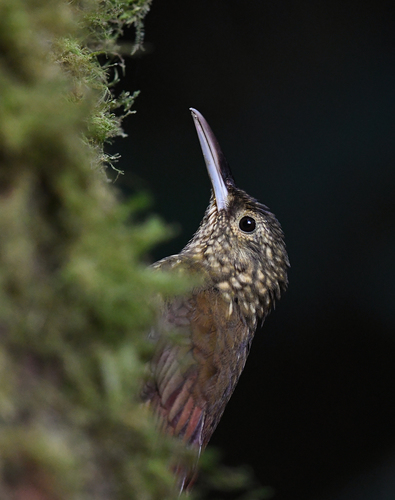
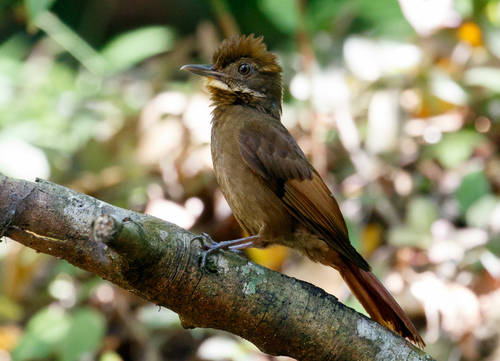
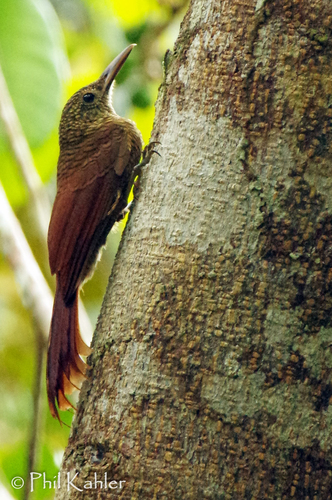
The Amazonian barred woodcreeper (Dendrocolaptes certhia) is one of the larger species in its subfamily. It has a slim build, a long tail, a medium-length straight bill with a slightly hooked tip, and males have a shaggy crest. The species measures 26 to 28.5 cm (10 to 11 in) in length. Males weigh 50 to 73.5 g (1.8 to 2.6 oz), while females weigh 52 to 79 g (1.8 to 2.8 oz). The sexes have identical plumage. Adults of the nominate subspecies D. c. certhia have a mostly brownish face with fine barring, a faint supercilium, and pale lores and auriculars. Their forehead to crown are darkish olive-brown, with golden-buff streaks on the crown. Their back and wing coverts are a lighter olive-brown with faint blackish bars. Their flight feathers, rump, and tail are cinnamon-rufous to rufous-chestnut, with dusky tips on the primaries. Their chin and throat are pale gray to dirty white, which contrasts with the deep buff to fulvous underparts; the underparts have fine dusky bars. Their underwing is cinnamon-rufous to ochre-yellow. Their iris is reddish to dark brown, their bill is dark red to brownish with lighter edges and base of the mandible, and their legs and feet can be brown, greenish, gray, olive, or black. Juveniles resemble adults, but have less obvious barring, no pale streaks on the crown, and a shorter, darker bill. Subspecies D. c. juruanus matches the nominate in appearance but lacks golden streaks on the crown. D. c. radiolatus is more richly colored than the nominate, more cinnamon-brown on the upperparts and ochraceous-brown on the underparts, with stronger and darker barring on the back and underparts. D. c. concolor has little to no barring, darker plumage, and a redder bill. D. c. ridgwayi is similar to concolor but has more obvious barring. D. c. medius and D. c. retentus are very similar to the nominate, but have a duller crown, a pale gray face, and paler underparts with weaker markings. The Amazonian barred woodcreeper is native to the Amazon Basin, with each subspecies occupying a distinct range. D. c. certhia is found in extreme eastern Colombia, southern and eastern Venezuela, the Guianas, and Brazil north of the Amazon River between the Rio Negro and the Atlantic Ocean in the state of Amapá. D. c. radiolatus occurs north of the Amazon River in southeastern Colombia, eastern Ecuador, northern and central Peru, and northwestern Brazil east to the Rio Negro. D. c. juruanus is found south of the Amazon River in southeastern Peru, northern and central Bolivia, and western Brazil east to the Rio Madeira and south into Mato Grosso. D. c. concolor inhabits northeastern Bolivia, and Brazil between the Rio Madeira and Rio Tapajós, known as the interfluvium. D. c. medius is found in northeastern Brazil south of the Amazon from the Rio Tocantins to the Atlantic in Maranhão state; it also occurs separately in coastal Pernambuco and Alagoas states, where it may be extirpated. D. c. retentus occupies the Rio Xingu-Rio Tocantins interfluvium in Brazil's Pará state. D. c. ridgwayi is found in Brazil south of the Amazon between the Rio Tapajós and Rio Xingu. The Amazonian barred woodcreeper inhabits humid evergreen forest. It prefers mature terra firme forest, but also occurs regularly in flooded and flood-plain forest. It is found less often in savanna forest, mangroves, and at the fringes of its range, deciduous and gallery forest. It is most common in the interior of primary forest, but occurs regularly at forest edges and in mature secondary forest. In terms of elevation, it mostly ranges from sea level to 900 m (3,000 ft), but reaches about 1,400 m (4,600 ft) in the tepuis of the Venezuela-Guyana-Brazil borderlands. In Colombia and Ecuador, it is most common below 600 m (2,000 ft).