About Dendrocitta vagabunda (Latham, 1790)
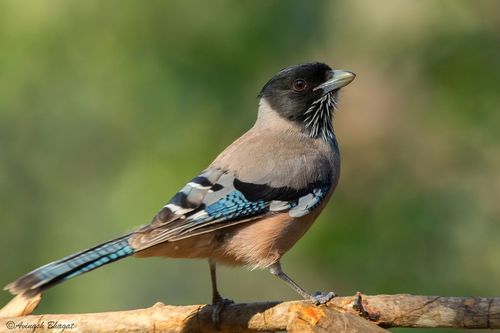
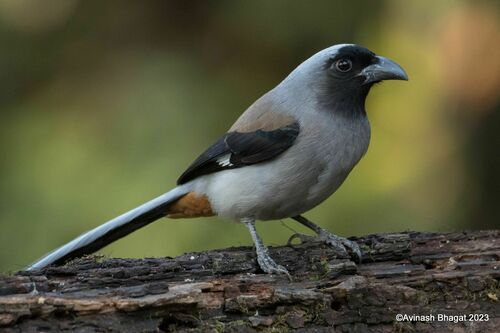
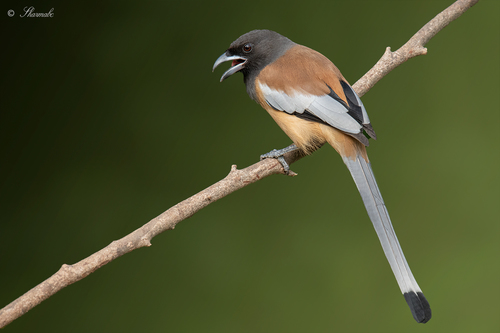
This species, Dendrocitta vagabunda (Latham, 1790), has sexes that are identical in appearance. The main body color is cinnamon, with a black head, a long graduated bluish grey tail tipped with black, and a white patch on the wing. Its bill is stout with a hooked tip. Underparts and lower back range from warm tawny-brown to orange-brown; it has white wing coverts, black primaries, and entirely black bill, legs, and feet. The only species it can be confused with is the grey treepie, which lacks the bright rufous mantle that this species has. Widespread populations display variation across the range, and several subspecies are recognized. The nominate subspecies occurs in the northeastern part of peninsular India, ranging south to Hyderabad. The paler desert-dwelling form is named pallida; vernayi from the Eastern Ghats is brighter, while parvula from the Western Ghats is smaller. The form found in Afghanistan and Pakistan is bristoli, and the form from southern Thailand is saturatior. E. C. Stuart Baker described sclateri from the upper Chindwin to the Chin Hills, and kinneari from southern Myanmar and northwest Thailand. Populations in eastern Thailand and Indochina are classified as sakeratensis. The rufous treepie has a very large range that covers Pakistan, India, and extends into Bangladesh, Myanmar, Laos, and Thailand. It inhabits open forest areas including scrub, plantations, and gardens. In the Garhwal Himalayas, it migrates seasonally between different elevations. The rufous treepie has a broad repertoire of calls, with a bob-o-link or ko-tree call being the most common. A local name for this bird, kotri, is derived from its typical call; other local names include Handi Chancha and taka chor, meaning "coin thief". In India, the breeding season runs from April to June. In Bengal, the peak of breeding falls in April and May, which corresponds to heightened pineal gland activity and increased serotonin production. It builds a shallow nest in trees and bushes, and usually lays 3 to 5 eggs per clutch.