About Dendrocitta leucogastra Gould, 1833
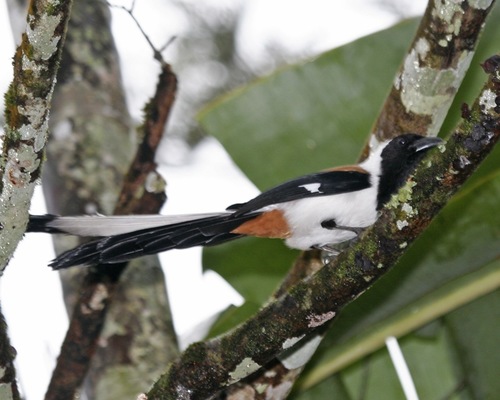
The white-bellied treepie, with scientific name Dendrocitta leucogastra Gould, 1833, can be easily distinguished from the sympatric rufous treepie by the white coloring on its head and body. It tends to live in denser forest and is less associated with human habitation than the rufous treepie. The white-bellied treepie is 48 cm (19 in) long. It has a white back of the neck, black throat and breast, black thighs, and chestnut undertail coverts. All other underparts are white. Its back is chestnut-brown. The wings are black with a white patch, and the rump is white. Two-thirds of the two central tail feathers are silver-grey, and the terminal third is black; all other tail feathers are black. The beak is black, and the legs are greyish-black. In terms of distribution, it is found in the forests of the Western Ghats mainly south of Goa. A record from Erimalai near Dharmapuri, plus reports from the Surat Dangs and the southeastern Ghats of Andhra Pradesh, fall outside its main distribution range. A published record from central India (Chikalda, Gawilgarh) has been questioned. Regarding behaviour and ecology, the white-bellied treepie eats fruits, seeds, nectar, invertebrates, reptiles, rodents, nestlings and eggs. When calling, the bird bows and droops its wings. During the pre-monsoon breeding season, which is mainly April–May though some nests appear from February, several birds may arrive at one tree and call repeatedly. The nest is a platform of twigs built on a medium-sized tree. Females lay three eggs, which are ashy grey with green and grey blotches. This species joins mixed-species foraging flocks, and is often found alongside greater racket-tailed drongos.