About Dendrocitta formosae Swinhoe, 1863
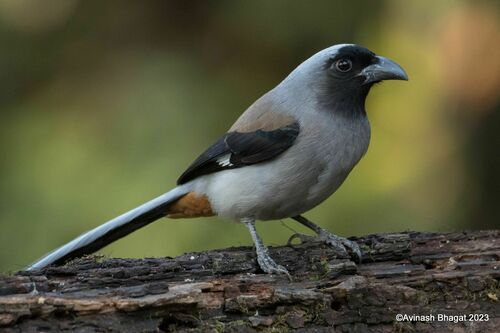
The grey treepie (Dendrocitta formosae Swinhoe, 1863) measures 36–40 cm (14–16 in) in length and weighs 89–121 g (3.1–4.3 oz). It matches the size of other species in the Dendrocitta genus, and is distinguished from them by its overall grey body coloration. Races in the western part of the species' distribution have a greyish rump and some grey coloring in the tail, while eastern forms have a white rump and a solid black tail. The face and throat are dark black, marked with a diffuse dark mask. The underside of the body is grey, fading to whiter coloration toward the vent. The back and scapulars are brownish. The crown and nape are greyish, and the black wing has a prominent white carpal patch. The vent is rufous, and the outer tail feathers and tips of the central tail feathers are black. The beak is black, the legs are blackish-brown, and the eyes are red or reddish-brown. Adult males and females are similar in appearance. Juvenile grey treepies are duller than adults, have a browner nape, and all of their feathers have rufous tips. This species covers a large geographical range, and has multiple recognised regional subspecies that differ slightly from one another in traits such as color and tail length. These subspecies include occidentalis from the western Himalayan foothills, which is identified by its slightly longer tail, and himalayana from the central Himalayas eastward into Thailand and Vietnam. A disjunct population called sarkari, found in the Eastern Ghats of peninsular India, is noted for having a smaller or narrower bill, and this subspecies is sometimes merged into himalayana. Southeast Asian races include assimilis, sapiens, sinica, the nominate race formosae from Taiwan, and insulae from Hainan Island. It has been proposed that this species forms a superspecies alongside Dendrocitta occipitalis and Dendrocitta cinerascens. The grey treepie is largely arboreal, and occurs in a wide range of habitats including forest, cultivated land, and areas of human habitation. Its distribution covers the Himalayan foothills, the Eastern Ghats of India, Bangladesh, Myanmar, Thailand, China, Hainan, Taiwan, and northern Indochina. In the Himalayas, it can be found up to 2,400 m (7,900 ft) above sea level, and in southeastern China it occurs between 400 m (1,300 ft) and 1,200 m (3,900 ft) elevation. This treepie feeds mostly in trees, but will also forage for some food on the ground, especially in cultivated regions. Its diet includes a wide variety of insects and other invertebrates, berries, nectar, grain and other seeds, and also small reptiles, eggs, and nestlings. It sometimes joins mixed-species foraging flocks. In the Himalayan foothills of Nepal, breeding occurs at elevations between 2000 and 6000 feet, mainly from May to July. The nest is a shallow cup lined with hair, built in trees, bushes, or clumps of bamboo, and clutches contain 3 to 4 eggs. Eggs can be whitish, buffish, or pale green, with brown or grey spots. Both the male and female help build the nest and feed the young birds. The grey treepie's voice is described as harsh and grating, but is quite varied like other related species. It includes a grating k-r-r-r-r sound as well as more melodious notes similar to those of the rufous treepie. Recorded calls include tiddly-aye-kok, ko-ku-la, and the barking braap...braap...braap call.