About Dendrocincla homochroa (P.L.Sclater, 1860)
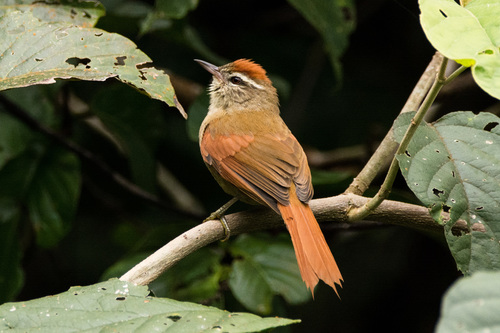
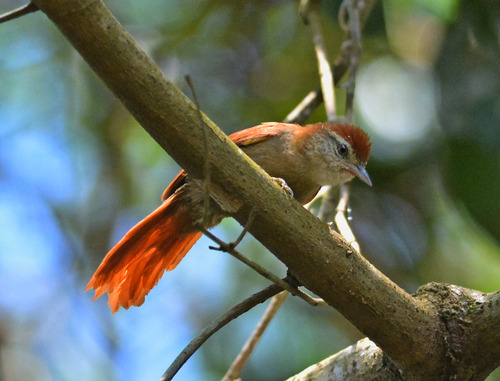
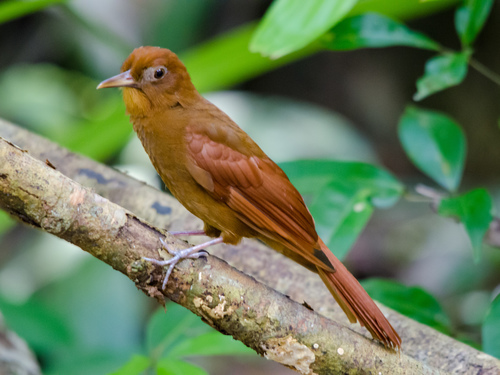
The ruddy woodcreeper, Dendrocincla homochroa, measures 17.5 to 20.5 cm (6.9 to 8.1 in) in length. Males weigh 34 to 45 g (1.2 to 1.6 oz), while females weigh 27 to 39 g (0.95 to 1.4 oz). This species is a medium-sized member of its genus. It has a straight bill, a short tail, and a large head with a ruffled nape. Males and females have identical plumage. The nominate subspecies has dark rufous to chestnut-brown upperparts, with a brighter reddish crown. Its wings, uppertail coverts, and tail are rufous chestnut, and the tips of its primaries are dusky. It has grayish lores and eyering, and a cinnamon-buff to tawny-ochraceous throat. Its underparts are rufous brown, with a paler belly and more rufous undertail coverts. Its underwing coverts are pale rufous. Its iris is reddish brown to pale chestnut-brown; its legs and feet are pale grayish to grayish brown. Its bill is highly variable in color: it can be dusky brownish, grayish, dull pinkish with a blackish tip, or entirely black. Subspecies D. h. acedesta is larger, darker, and more olive than the nominate, and its throat and belly are less pale. D. h. ruficeps is slightly larger than D. h. acedesta, has a heavier bill, and is slightly paler overall. D. h. meridionalis has a darker chestnut crown and darker, more olive-brown upperparts than the other three subspecies. The subspecies of the ruddy woodcreeper have separate ranges. D. h. homochroa is found on both slopes of southern Mexico, extending south through Belize, Guatemala, a small portion of El Salvador, and Honduras into northeastern Nicaragua. D. h. acedesta occurs on the Pacific slope from southwestern Nicaragua through Costa Rica into western Panama, and also on the Caribbean slope of northern and central Costa Rica. D. h. ruficeps is found in central and eastern Panama, and extends slightly into northwestern Colombia. D. h. meridionalis is found in northern Colombia and northwestern Venezuela. The ruddy woodcreeper lives in a variety of forest landscapes, including lowland deciduous forest, rainforest, cloudforest, and gallery forest. It favors the interior of mature primary and secondary forest, but also occurs at forest edges, in younger secondary forest, and in semi-open areas with scattered trees. It is generally found in lowlands and foothills. At the northernmost edge of its range, it occurs at elevations between 1,300 and 1,550 m (4,300 and 5,100 ft). In northern Central America it can reach elevations as high as 1,650 m (5,400 ft), but is most common between 300 and 1,200 m (1,000 and 3,900 ft). In Costa Rica it mostly occurs between 500 and 1,200 m (1,600 and 3,900 ft), and in Panama between 300 and 900 m (1,000 and 3,000 ft). It is typically found below 1,500 m (4,900 ft) in Colombia, and below 450 m (1,500 ft) in Venezuela.