About Dendrocincla fuliginosa turdina (Lichtenstein, 1820)
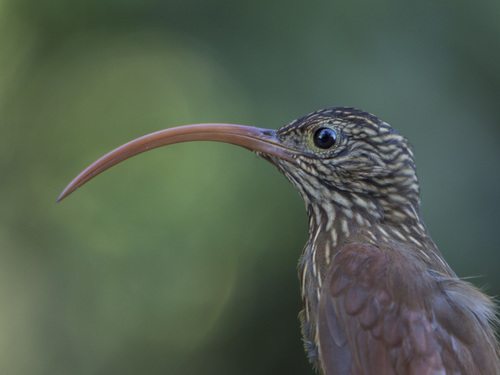
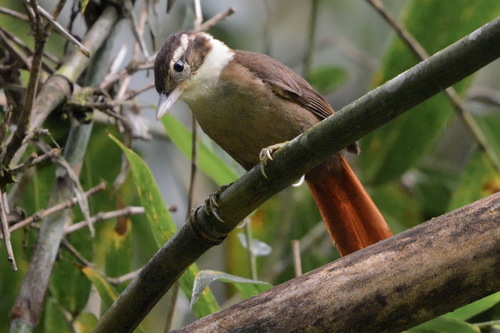
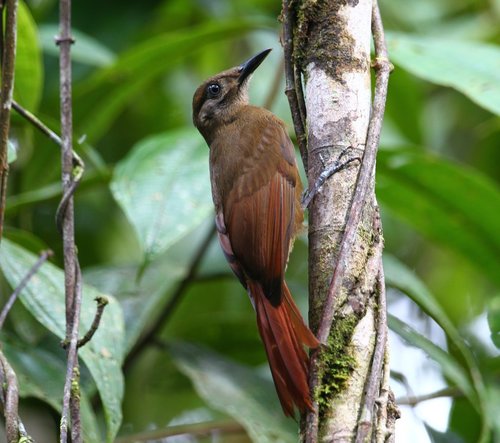
This entry covers the plain-brown woodcreeper, with the scientific subspecies name Dendrocincla fuliginosa turdina (Lichtenstein, 1820). The plain-brown woodcreeper measures 19 to 22.5 cm (7.5 to 8.9 in) in length. Males weigh 30 to 50 g (1.1 to 1.8 oz), while females weigh 25 to 46 g (0.88 to 1.6 oz). It is a medium-sized member of its genus, with a straight medium-length bill and a slight crest. The sexes share identical plumage, but females are smaller than males. The nominate subspecies D. f. fuliginosa has a narrow buff supercilium and a faint buff stripe under an otherwise grayish face. Its crown, nape, back, and wing coverts are dull olive-brown; its uppertail coverts and tail are rufous-chestnut. Its wings are rufous-chestnut, with dusky outer edges and tips on the primaries. Its throat is pale gray to buffy with fine mottling. Its breast and belly are paler olive-brown than its back, with fine buff streaks on the breast. Its undertail coverts are cinnamon-rufous, and its underwing coverts are cinnamon-buff to ochraceous. Its iris ranges from yellowish brown to dark brown or pale gray, its bill is black with whitish, yellowish, or gray edges and tip, and its legs and feet can be black, slate gray, dark brownish olive, or light blue. Other subspecies of the plain-brown woodcreeper differ from the nominate as follows: D. f. ridgwayi is more rufescent, has less mottling and streaking, a less grayish throat, and a black bill. D. f. lafresnayei is more olivaceous especially on the belly, has less mottling and streaking, a grayer throat, and a blackish brown bill. D. f. meruloides is quite rufescent, has less mottling and streaking, little contrast between throat and breast, and a paler mandible than maxilla. D. f. deltana has less mottling and streaking, little contrast between throat and breast, and a paler mandible than maxilla. D. f. barinensis has darker and browner upperparts, less mottling and streaking, more dusky underparts, and a paler mandible than maxilla. D. f. phaeochroa has darker and more olivaceous upperparts, less mottling and streaking, a much whiter throat, and a paler mandible than maxilla. D. f. neglecta has darker and more olivaceous upperparts than phaeochroa, paler underparts, less mottling and streaking, and a paler mandible than maxilla. D. f. atrirostris is more rufescent, has a bold supercilium, conspicuous streaks on the crown, and a paler mandible than maxilla. D. f. rufoolivacea is duller and more olivaceous overall, with a less streaky neck. D. f. trumaii is more greenish than all other subspecies, and has a bold supercilium and conspicuous streaks on the crown. The subspecies of the plain-brown woodcreeper have the following distribution ranges: D. f. ridgwayi occurs from northeastern Honduras through Nicaragua, Costa Rica, Panama, western Colombia, and western Ecuador into northwestern Peru. D. f. lafresnayei is found in northern and eastern Colombia and adjoining northwestern Venezuela. D. f. meruloides inhabits northern Venezuela, Trinidad, and Tobago. D. f. deltana is found in the delta of the Orinoco River in northeastern Venezuela. D. f. barinensis occurs in north-central Colombia and west-central Venezuela. D. f. phaeochroa is found in the Amazon Basin of southeastern Colombia, southern Venezuela, and northwestern Brazil. D. f. neglecta occurs in the western Amazon Basin on both sides of the Amazon River from eastern Ecuador and eastern Peru to the Rio Negro and Rio Madeira. D. f. atrirostris inhabits the southwestern Amazon Basin in southeastern Peru, northern and central Bolivia, and southwestern Brazil as far as the Rio Tapajós. D. f. fuliginosa is found in the Amazon Basin north of the Amazon River in southeastern Venezuela, the Guianas, and northern Brazil between the Rio Negro and the Atlantic Ocean. D. f. rufoolivacea occurs in Brazil south of the Amazon River between the Rio Tapajós and the state of Maranhão. D. f. trumaii is found in the upper Rio Xingu in Brazil's Mato Grosso state. The plain-brown woodcreeper inhabits a variety of humid forest landscapes. It is most common in evergreen forest, and occurs less frequently in deciduous forest, gallery forest, rainforest, and forest growing on sandy soils. It is occasionally found in mangroves. In the Amazon Basin it mostly inhabits terra firme and floodplain forests, and occurs less frequently in várzea and swamp forests. It mostly favors the interior of primary forest, but is frequently found at forest edges and in mature secondary forest. It is uncommon in young secondary forest, bamboo, and plantations. It is a bird of the lowlands and foothills, and seldom occurs above 1,300 m (4,300 ft). In terms of elevation, it is mostly found below 750 m (2,500 ft) in Honduras, below 900 m (3,000 ft) in Costa Rica, below 1,200 m (3,900 ft) in Colombia, and below 1,100 m (3,600 ft) in Ecuador. It does reach 2,000 m (6,600 ft) near the Caribbean coast in Colombia and Venezuela.