About Dendrobium speciosum Sm.
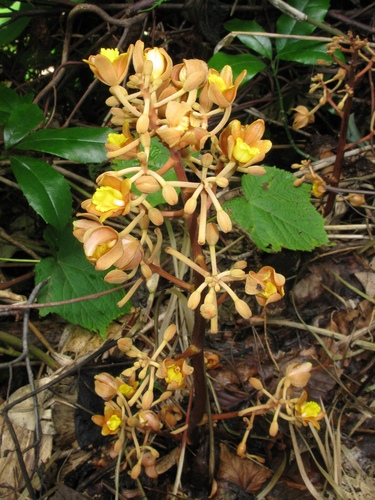
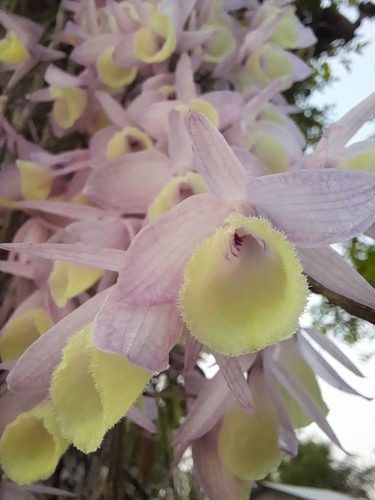
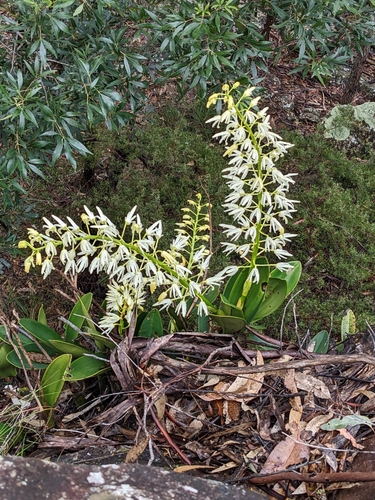
Dendrobium speciosum Sm. is an epiphytic or lithophytic herb that has spreading roots, along with cylindrical or tapered pseudobulbs that measure 50–1,800 mm (2–70 in) long and 10–60 mm (0.4–2 in) wide. Each pseudobulb produces up to seven, typically thick and leathery leaves from its top; these leaves are 50–250 mm (2–10 in) long and 10–80 mm (0.4–3 in) wide, and can remain attached to the plant for up to twelve years. The flowers of this species range in color from white to bright yellow, and there is substantial variation in the length of flowering racemes, the number of flowers per raceme, and individual flower size. Flowering stems grow 50–800 mm (2–30 in) long, and carry between two and two hundred flowers. Individual flowers measure 12–70 mm (0.5–3 in) long and 20–80 mm (0.8–3 in) wide. The dorsal sepal is longer and narrower than the lateral sepals, while the petals are roughly the same length as the lateral sepals but only half as wide. The labellum has three lobes and reddish purple spots or streaks: the side lobes are erect and curved, and the middle lobe is pointed, rounded, or roughly square. For most varieties, flowering occurs between August and October, though some varieties flower as early as May and others as late as November. Potential pollinators of Dendrobium speciosum, including the stingless bee Tetragonula carbonaria, are drawn to the species by its large, cream to yellow, finely segmented, aromatic inflorescences. Flower size varies across the six recognised varieties of D. speciosum, and pollination occurs when the flowers are visited by bees of an appropriate size. This orchid is popular in cultivation. It grows into a large specimen that performs well outdoors in climates with mild winters. It can be grown in an open, coarse orchid growing medium, mounted on a sturdy tree with an open canopy, or grown as a terrestrial plant in a well-drained location. It needs very bright light to full sun, and requires moderate watering year-round. It is quite temperature tolerant as long as it gets adequate warmth during the growing season. Frost can cause severe, extensive defoliation, and the plant may take years to recover from this damage. In cultivation, D. speciosum can grow extremely large pseudobulbs, and benefits from regular fertilisation. Even under ideal cultivation conditions, it may not flower every year; this is especially common for plants originating from more southern populations.