About Dendrobium smillieae F.Muell.
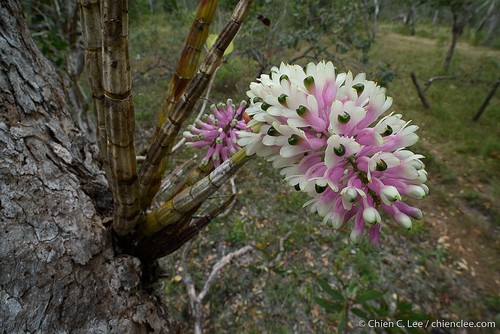
Dendrobium smillieae F.Muell. is an epiphytic or lithophytic herb that forms crowded, ribbed, greenish or yellowish spindle-shaped pseudobulbs. These pseudobulbs measure 0.3–1.0 m (1–3 ft) long and 20–30 mm (0.8–1 in) wide. Pseudobulbs produce leaves in their first year and become leafless when mature. Its leaves are bright green, thin, often twisted, 150–200 mm (6–8 in) long and 30–40 mm (1.2–1.6 in) wide. Flowers grow in crowded, bottlebrush-like clusters that are 80–150 mm (3–6 in) long at the end of pseudobulbs. Individual flowers are white, greenish, cream-colored, or pink, roughly tube-shaped, and 20–25 mm (0.79–0.98 in) long. The sepals and petals are blunt, 7–10 mm (0.28–0.39 in) long, and do not open widely. The labellum is about 16 mm (0.6 in) long and 3–4 mm (0.1–0.2 in) wide, with a shiny dark green tip. Flowering occurs from August to November. A white-flowered variety of this orchid occurs in the Sepik swamps of New Guinea. Commonly called the bottlebrush orchid, this species is widespread and common. It grows on trees, and sometimes on rocks, in woodland, forest, and rainforest margins. It prefers sun-exposed trees, and very commonly grows on species like Lophostemon suaveolens (swamp turpentine or swamp box), which has loose papery bark. The orchid's roots grow under the tree's bark, where they form large, well-protected mats. Its distribution range includes New Guinea, the Bismarck Archipelago, the Aru Islands, some Torres Strait Islands, and Cape York Peninsula in Queensland, Australia, extending south as far as Townsville. The flowers of Dendrobium smillieae produce nectar, and are pollinated by the yellow honeyeater (Stomiopera flava), which is also called the canary honeyeater in Queensland. The bird hovers in front of the flowers while feeding on the nectar.