About Dendrobium schoeninum Lindl.
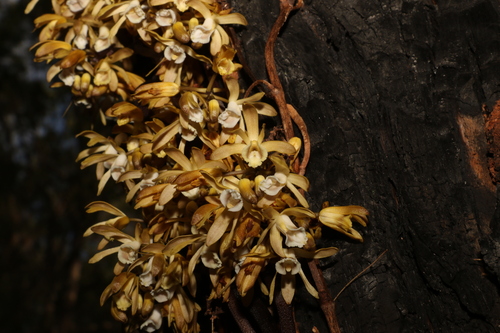
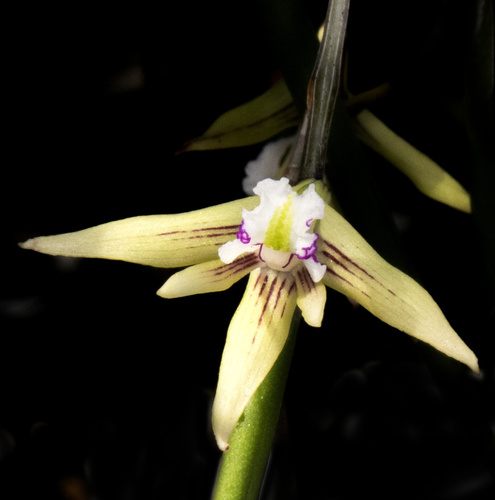
Dendrobium schoeninum, commonly known as the common pencil orchid, is an epiphytic and occasionally lithophytic herb. It has thin, upright or pendent stems 300 to 900 mm (10 to 40 inches) long, around 3 mm (0.1 inches) wide, with many branches. Its leaves are cylindrical, fleshy, dark green, grooved, 60 to 160 mm (2 to 6 inches) long and 2 to 12 mm (0.08 to 0.5 inches) wide. The 10 to 30 mm (0.4 to 1 inch) long flowering stems carry between one or two flowers, rarely up to four. The flowers are pale green, cream-coloured or mauve with purple stripes. The sepals and petals spread apart from each other; sepals are 18 to 24 mm (0.71 to 0.94 inches) long and about 3.5 mm (0.14 inches) wide, while petals are a similar length but narrower. The labellum is cream-coloured to pale green with purple markings, about 20 to 30 mm (0.8 to 1 inch) long and 7 to 10 mm (0.3 to 0.4 inches) wide, and has three lobes. The side lobes are narrow and upright, while the middle lobe curves downward, has wavy edges, and bears three wavy ridges along its midline. Flowering of this species takes place from August to November. In terms of distribution and habitat, the common pencil orchid grows at rainforest edges, near creeks, or on the branches of river oak (Casuarina cunninghamiana) or swamp she-oak (C. glauca). It sometimes also grows on shady rocks and cliff faces. It is found in near-coastal areas between Gladstone in Queensland and the Hunter River in New South Wales.