About Dendrobium pugioniforme A.Cunn. ex Lindl.
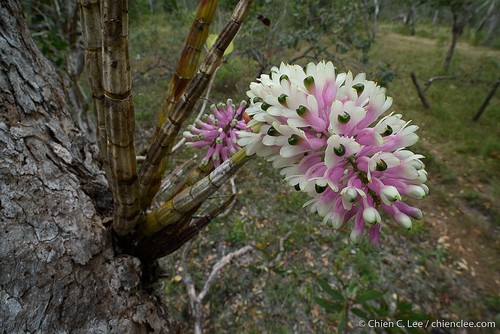
Dendrobium pugioniforme A.Cunn. ex Lindl. is an epiphytic or lithophytic herb. It produces pendulous, wiry, branched stems that measure 0.3–2 m (1–7 ft) long and approximately 2 mm (0.08 in) wide. Its leaves are pendulous, thick, green, and egg-shaped, with a sharply pointed tip; they grow 30–70 mm (1–3 in) long and 15–20 mm (0.59–0.79 in) wide. The 40–70 mm (2–3 in) long flowering stem emerges from the base of a single leaf, and holds one or two flowers that range in color from pale green to pale brown or yellowish. Individual flowers are 10–15 mm (0.39–0.59 in) long and 15–20 mm (0.59–0.79 in) wide, with brown striations near the base. The dorsal sepal is 9–12 mm (0.35–0.47 in) long and about 3 mm (0.12 in) wide; lateral sepals are slightly longer and wider than the dorsal sepal, and petals are slightly narrower. The labellum is white, 13–18 mm (0.5–0.7 in) long and 6–9 mm (0.2–0.4 in) wide, and is divided into three main lobes. The side lobes are short and curve upwards, while the middle lobe also curves upwards and bears three wavy ridges. Flowering occurs between September and November.
Commonly called the dagger orchid, this species grows on trees and rocks in humid forest, ranging from the Bunya Mountains in south-east Queensland to Tathra in New South Wales. It occurs from sea level up to altitudes of 1,000 m (3,000 ft).
In horticulture, Dendrobium pugioniforme adapts readily to cultivation. It can be grown in baskets using epiphytic orchid mix, or trained to grow on rock or bark slabs. It prefers a part-shaded position and requires extra moisture.