About Dendrobium kingianum Bidwill ex Lindl.
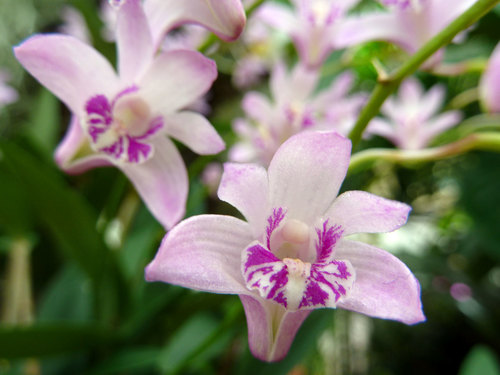
Dendrobium kingianum Bidwill ex Lindl., commonly called the pink rock orchid, is most often a lithophyte, occasionally an epiphyte, and very rarely a terrestrial plant. Within its natural range, it grows on boulders and in rock crevices in open forest, near forest creeks, and on cliff faces. It sometimes grows as a single individual plant, but can also form large colonies spanning several metres across. Its spongy, white roots allow it to absorb water quickly from a wet rock surface, and reflect light during long dry spells to prevent overheating. Its stems, also called pseudobulbs, may be erect or spreading, and are always succulent, functioning as a water storage organ during dry periods. Roots grow from the thicker base end of the pseudobulb, which tapers toward the tip. Pseudobulbs are 5–30 cm (2–10 in) long and 1–2.5 cm (0.4–1 in) in diameter, and bear between three and six leaves near the tip. The leaves are thin, green, smooth, folded along the mid-line, and narrow egg-shaped, measuring 3–10 cm (1–4 in) long and 10–20 mm (0.39–0.79 in) wide. Flowers are arranged in a 7–15 cm (3–6 in) long raceme that holds between two and fifteen flowers. The sepals and petals are usually pink, but may be pure white, dark purple, or any intermediate color. The dorsal sepal is 9–16 mm (0.4–0.6 in) long and 4–7 mm (0.2–0.3 in) wide. The labellum is 8–15 mm (0.3–0.6 in) long and 7–12 mm (0.3–0.5 in) wide, and usually has dark purple markings. Flowering most often occurs from August to October, which is late winter to mid-spring in the southern hemisphere, but can happen earlier or later in response to climate cues. This orchid is distributed from the coast to nearby ranges between the Hunter River in New South Wales and Rockhampton in Queensland, and usually grows on rock in forest and woodland. The pink rock orchid is popular in cultivation of Australian native orchids, and is relatively easy to grow. It can be grown successfully on bark, fixed to rock, or in a fast-draining medium made of coarse bark and river pebbles. It grows best in a warm, sunny position, and prefers relatively high humidity during its growing season from August to March. It is adapted to the dry winters of Australia’s east coast, and flowers best after a period of dry dormancy. It is available for purchase from specialist orchid nurseries, but like many Australian native plants, collecting wild-grown specimens is illegal.