About Dendrelaphis grandoculis (Boulenger, 1890)
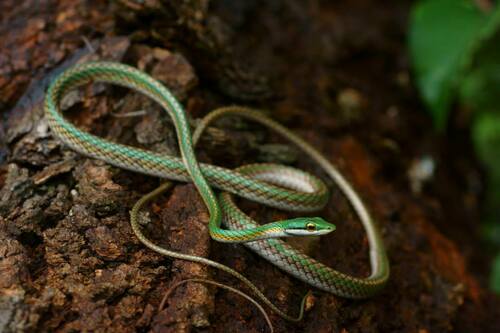
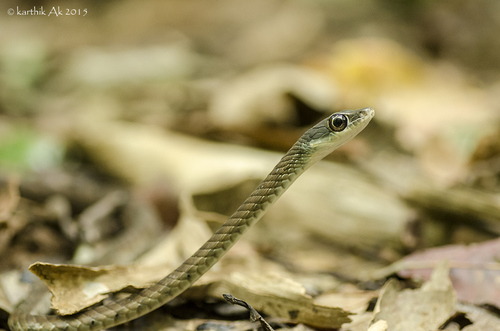
This species, Dendrelaphis grandoculis, has an extremely large eye, whose length equals the distance from the eye to the rostral. The rostral scale is much broader than it is long, and is visible from above; its upper border is nearly straight. The suture between the internasal scales is as long as the suture between the prefrontal scales, or slightly longer. The frontal scale is as long as the distance from the scale to the tip of the snout, and matches the length of the parietal scales. The loreal scale is elongated. There is one preocular scale and two postocular scales; temporals are arranged 2+2. There are 9 upper labial scales, with the fourth, fifth, and sixth entering the eye. 5 lower labial scales contact the anterior chin-shields, which are shorter than the posterior chin-shields. Dorsal scales are arranged in 15 rows, with vertebral scales nearly the same size as the outer row of scales. It has 170–174 ventral scales; the anal scale is divided, and it has 117 subcaudal scales. The dorsal body is olive-brown, with irregular small black blotches; the eye is edged with whitish, and the underparts are pale olive. Total body length reaches 4 feet, with the tail measuring 13 and a half inches, this description follows the original work by Boulenger. This species is endemic to the Western Ghats. It has been recorded from Agasthyamalai, Travancore hills, Periyar Tiger Reserve, Anaimalai, Waynad, Coorg, and the Malnad region of Karnataka, with its range extending north to Castle Rock near Goa. Compared to other bronzeback snakes, this species is rather slow in speed. It slithers across tree branches to forage for lizards, frogs, and small birds. It is a diurnal, arboreal, forest-dwelling snake, and favors rainforests. It is rarely found in plantations and monocultures.